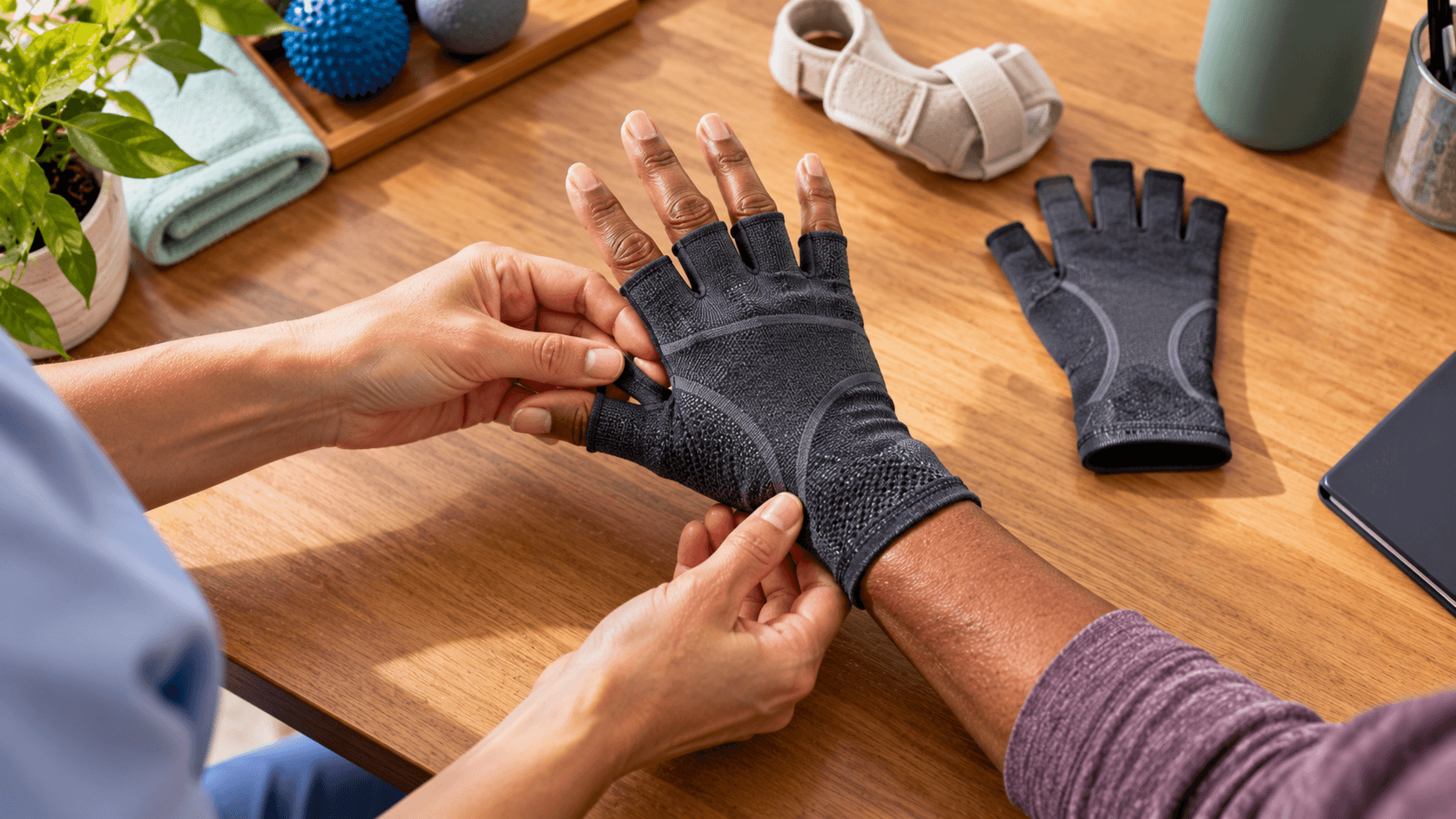
Arthritis gloves and TENS units are common at-home products marketed for osteoarthritis pain. Gloves may provide warmth, light compression, or a sense of support for hand symptoms. TENS units send mild electrical stimulation through pads placed on the skin. Some people feel short-term comfort from these tools, but the evidence is mixed and the safety details matter.
Osteoarthritis is not just “wear and tear.” It is a whole-joint condition that can involve cartilage, bone, ligaments, tendons, muscles, inflammation, pain processing, strength, movement habits, and daily activity. A home tool may help with comfort, but it does not reverse osteoarthritis or replace exercise, weight management when appropriate, topical or oral medicines when recommended, bracing when indicated, hand therapy, physical therapy, or clinician follow-up.
This guide explains what arthritis gloves and TENS units may help with, what they do not do, what features to compare before buying, and when to stop using them.
Start With the Joint and the Goal
Osteoarthritis can affect the hands, knees, hips, spine, feet, and other joints. The right support tool depends on where symptoms are, what activity is limited, and whether the goal is warmth, comfort, stability, sleep, grip, walking, or temporary pain relief.
The American College of Rheumatology and Arthritis Foundation guideline for hand, hip, and knee osteoarthritis strongly recommends several core approaches, including exercise, self-management programs, tai chi, cane use when needed, hand orthoses for first carpometacarpal joint osteoarthritis, tibiofemoral knee bracing when appropriate, topical NSAIDs for knee osteoarthritis, oral NSAIDs when appropriate, and intra-articular glucocorticoid injections for knee osteoarthritis.
That matters because gloves and TENS units should usually be viewed as add-on comfort tools, not the foundation of osteoarthritis care.
Tool 1: Arthritis Gloves
Arthritis gloves are usually soft gloves designed to provide warmth, light compression, or both. Some are fingerless so people can type, cook, grip, or do household tasks while wearing them.
- May feel soothing for hand stiffness or cold-sensitive discomfort
- May provide mild compression and sensory support
- May help some people remember to protect irritated joints during tasks
- Do not realign damaged joints or stop osteoarthritis progression
The ACR/Arthritis Foundation guideline notes that gloves may offer benefit by providing warmth and compression to hand joints, but this should be interpreted as possible symptom support rather than a cure.
What Arthritis Gloves May Help With
Gloves may be worth trying if symptoms are mainly in the hands and the goal is comfort during low-risk daily activities.
- Morning hand stiffness
- Cold-sensitive hand discomfort
- Mild swelling sensation
- Grip discomfort during light tasks
- Comfort during typing, reading, or household activities
A glove trial should focus on function: Can you button clothing more easily? Do jars feel less painful? Do morning tasks feel smoother? Do you sleep better if your hands stay warm?
What Arthritis Gloves Do Not Do
Arthritis gloves are often marketed more strongly than the evidence supports.
- They do not rebuild cartilage.
- They do not diagnose whether pain is osteoarthritis, rheumatoid arthritis, carpal tunnel syndrome, gout, tendon irritation, or nerve pain.
- They do not replace splints or orthoses when a specific joint needs support.
- They do not replace hand therapy, strengthening, joint-protection strategies, or medical evaluation.
NIHR Evidence summarized a randomized trial finding that special arthritis gloves were no better than looser-fitting ordinary gloves for hand pain and function, and that there was very little prior research evidence that they work.
Arthritis Glove Feature Checklist
If you decide to try gloves, compare comfort and safety first.
- Correct size based on hand measurements
- Light, even compression without tight bands
- Soft seams that do not rub painful joints
- Breathable fabric
- Fingerless or full-finger design based on tasks
- Washable material
- Return policy if fit is poor
Compression should feel supportive, not restrictive. A glove that leaves deep marks, causes numbness, or changes finger color is too tight or not appropriate.
When to Stop Using Arthritis Gloves
Stop using gloves and reassess if symptoms get worse or circulation seems affected.
- New numbness or tingling
- Finger color changes, such as pale, blue, or purple fingers
- Increased swelling above or below the glove
- Skin rash, blisters, itching, or pressure sores
- Worsening stiffness after use
- Loss of grip or increased clumsiness
People with neuropathy, circulation problems, Raynaud’s phenomenon, skin breakdown, severe swelling, or reduced hand sensation should ask a clinician before using compression gloves.
Tool 2: TENS Units
TENS stands for transcutaneous electrical nerve stimulation. A TENS unit sends mild electrical pulses through electrode pads placed on the skin. The goal is usually temporary pain modulation, not joint repair.
- May create tingling or pulsing sensations
- May temporarily distract from pain for some people
- Requires correct pad placement and safe settings
- Has mixed or limited evidence for osteoarthritis, depending on the joint and study
NICE’s osteoarthritis guideline says not to offer TENS to people with osteoarthritis because there is insufficient evidence of benefit.
What TENS May Help With
Some people report temporary pain relief while TENS is on or shortly afterward. If a clinician says it is reasonable for your situation, a careful short trial may help you decide whether it improves comfort or function.
- Short-term pain distraction during rest
- Comfort before or after gentle activity
- Support during a broader physical therapy plan
- Temporary relief when medication options are limited
The important word is “temporary.” If TENS helps, it should make daily activity safer or more manageable. It should not become a reason to ignore worsening pain, swelling, weakness, or function loss.
What TENS Does Not Do
TENS should not be sold or used as a joint-repair tool.
- It does not rebuild cartilage.
- It does not correct joint alignment.
- It does not strengthen muscles.
- It does not replace exercise or physical therapy.
- It does not diagnose the cause of pain.
- It does not make severe or worsening symptoms safe to ignore.
The ACR/Arthritis Foundation guideline strongly recommends against TENS for knee and hip osteoarthritis, citing low-quality studies and evidence that did not adequately show benefit.
TENS Feature Checklist
If a clinician or physical therapist says a TENS trial is appropriate, compare safety and control features.
- Low starting intensity
- Clearly labeled modes and intensity controls
- Session timer or automatic shutoff
- Easy stop button
- Reusable pads with clear replacement instructions
- Readable manual with pad placement warnings
- Customer support and replacement parts
A TENS unit should be easy to stop quickly. Avoid devices that make it hard to lower intensity, pause treatment, or understand pad placement.
TENS Safety Warnings
TENS is not appropriate for everyone. Ask a clinician before use if you have a pacemaker, defibrillator, spinal cord stimulator, implanted pump, seizure disorder, heart rhythm problems, pregnancy, cancer near the treatment area, reduced sensation, skin wounds, or unexplained pain.
- Do not place pads over the front of the neck.
- Do not place pads across the chest unless specifically instructed by a clinician.
- Do not use on broken, infected, irritated, or numb skin.
- Do not use while driving, bathing, sleeping, or operating machinery.
- Do not increase intensity until it is painful.
The FDA warns that electrical stimulation devices can interfere with implanted devices such as pacemakers and defibrillators, and that unsafe electrical devices may cause shocks or other hazards.
When to Stop Using TENS
Stop TENS and contact a clinician if it causes new symptoms or skin problems.
- Burning, rash, blisters, or skin irritation under pads
- Increased pain during or after use
- Numbness, weakness, dizziness, or faintness
- Heart palpitations or chest discomfort
- Headache, confusion, or unusual symptoms
- No meaningful improvement after a reasonable short trial
If TENS does not improve function, sleep, walking, hand use, or comfort within the trial period your clinician recommended, it may not be worth continuing.
Arthritis Gloves vs. Hand Orthoses
Arthritis gloves are not the same as hand orthoses or splints. A glove usually provides warmth and mild compression. An orthosis is designed to support or position a specific joint.
- Gloves may help general hand comfort.
- Thumb-base orthoses may help first carpometacarpal joint osteoarthritis.
- Finger splints may be used for selected joint alignment or stability issues.
- Occupational therapists can help fit hand supports for daily tasks.
The ACR/Arthritis Foundation guideline strongly recommends hand orthoses for first carpometacarpal joint osteoarthritis and conditionally recommends other hand orthoses for hand osteoarthritis.
TENS vs. Knee Braces
For knee osteoarthritis, bracing may have stronger guideline support than TENS for selected people. A knee brace may help with stability, alignment support, or confidence during walking, while TENS focuses on temporary pain modulation.
- Tibiofemoral knee braces may help selected people with knee osteoarthritis that affects walking, stability, or pain.
- Patellofemoral braces may help selected people depending on pain location and fit.
- A poorly fitted brace can cause skin irritation, slipping, or discomfort.
- A physical therapist or clinician can help decide whether bracing is appropriate.
The ACR/Arthritis Foundation guideline strongly recommends tibiofemoral knee bracing for tibiofemoral knee osteoarthritis when the disease affects walking, joint stability, or pain enough to warrant an assistive device and the person can tolerate the brace burden.
Heat, Cold, and Paraffin: Where They Fit
Heat and cold may be simpler options than a device. Heat can feel helpful for stiffness. Cold can feel helpful after activity or during swelling. Paraffin wax baths are sometimes used for hand comfort.
- Use heat for stiffness or muscle tension if skin sensation is normal.
- Use cold for swelling or irritated joints if circulation and sensation are normal.
- Do not use heat or cold over numb skin, open wounds, infection, or poor circulation without guidance.
- Stop if skin becomes painful, pale, blistered, or unusually red.
The ACR/Arthritis Foundation guideline conditionally recommends thermal interventions for knee, hip, and hand osteoarthritis and conditionally recommends paraffin for hand osteoarthritis.
Buying Checklist: Arthritis Gloves
Before buying gloves, compare fit, comfort, and real-world use.
- Measure your hand before choosing a size.
- Choose mild compression rather than tight compression.
- Check whether seams cross painful joints.
- Decide whether fingerless or full-finger gloves fit your tasks.
- Choose breathable, washable material.
- Check whether you can return them after trying the fit.
- Avoid claims that gloves reverse arthritis or repair joints.
The best glove is one you can wear comfortably during the tasks that matter to you. If it only feels good at rest but makes activities harder, it may not be useful.
Buying Checklist: TENS Units
Before buying a TENS unit, ask whether it is safe for you and whether it fits the joint you want to treat.
- Clinician or physical therapist approval if you have medical risks
- Clear pad placement instructions
- Adjustable intensity and low starting setting
- Session timer
- Easy-to-use controls
- Replacement pads and battery or charging information
- Warnings for implanted devices, pregnancy, seizures, heart conditions, and skin problems
Do not buy a TENS unit because it promises to “heal” osteoarthritis. If you try one, use it as a short-term comfort test within a broader plan.
How to Run a Safe Trial
Try one tool at a time so you can tell what helps and what causes problems.
- Choose one goal, such as easier morning hand use or less pain during a short walk.
- Use the tool for a defined short trial, such as 1 to 2 weeks unless your clinician advises otherwise.
- Record pain before and after use.
- Record function, such as grip, stairs, walking, sleep, or activity tolerance.
- Stop if symptoms worsen or skin changes appear.
A tool is worth continuing only if it improves comfort or function without causing new problems.
What to Track While Using Gloves or TENS
A short log can help you decide whether the product is useful.
- Joint: hand, thumb, knee, hip, or other area
- Tool: glove, TENS, brace, heat, cold, or other support
- Use: time worn, TENS setting, pad location, or activity
- Response: pain, stiffness, swelling, warmth, grip, walking, or sleep
- Side effects: rash, numbness, tingling, increased pain, skin marks, or dizziness
- Function: what you could do more easily or less easily
Bring the log to a clinician, physical therapist, or occupational therapist if the tool is not helping or symptoms are changing.
Common Mistake: Expecting Gloves to Fix Joint Damage
Gloves may provide warmth or comfort, but they do not rebuild cartilage or correct joint structure.
If hand pain is limiting daily tasks, ask whether hand therapy, thumb-base orthosis, joint-protection strategies, topical medicine, or another evaluation is more appropriate.
Do not keep buying more gloves if the first well-fitted pair does not improve function.
Common Mistake: Using TENS Instead of Moving Safely
TENS may provide temporary sensation-based pain relief for some people, but it does not strengthen muscles, improve joint range, or build walking tolerance.
Exercise remains a core osteoarthritis management strategy in guidelines.
If pain relief does not help you move better or function better, the device may not be adding much.
Common Mistake: Ignoring Skin and Circulation
Gloves, braces, pads, heat, cold, and tape can all irritate skin or affect circulation.
Check skin after use.
Stop for blisters, burns, color change, swelling, numbness, tingling, or deep pressure marks.
Common Mistake: Treating Every Joint the Same
Hand osteoarthritis, thumb-base osteoarthritis, knee osteoarthritis, and hip osteoarthritis do not all respond to the same tools.
A glove may make sense for hand comfort. A thumb orthosis may make more sense for thumb-base pain. A knee brace may make sense for selected knee instability. TENS has weaker guideline support for knee and hip osteoarthritis.
Match the tool to the joint and the problem.
Common Mistake: Delaying Care for New Symptoms
Osteoarthritis can flare, but new severe symptoms should not be assumed to be “just arthritis.”
New swelling, redness, fever, sudden inability to bear weight, major weakness, numbness, or severe night pain needs evaluation.
Do not use gloves or TENS to mask a new problem.
When to Talk to a Clinician
Talk to a clinician, physical therapist, or occupational therapist if osteoarthritis pain is worsening, daily function is declining, sleep is disrupted, walking is limited, grip is weakening, or self-care tools are not helping after a short trial.
You should also ask before using TENS if you have a pacemaker, defibrillator, implanted stimulator, seizure disorder, pregnancy, heart rhythm concerns, reduced sensation, cancer near the treatment area, skin wounds, or unexplained pain.
A clinician may recommend exercise therapy, hand therapy, occupational therapy, topical NSAIDs, oral medicines when appropriate, braces or orthoses, cane use, injections, weight-management support when relevant, imaging if needed, or referral to orthopedics or rheumatology depending on symptoms and joint involved.
When to Seek Urgent or Emergency Care
Seek urgent or emergency care for a red, hot, severely swollen joint; fever with joint pain; sudden inability to bear weight; major injury; severe weakness; new numbness; chest pain; severe shortness of breath; stroke symptoms; fainting; or symptoms that feel life-threatening.
Seek prompt care for rapidly worsening pain, new deformity, severe night pain, unexplained weight loss, signs of infection, or pain with a history of cancer or recent surgery.
Do not wait for an arthritis glove, TENS unit, or home support tool to fix symptoms that could signal infection, fracture, inflammatory arthritis, blood clot, nerve compression, or another urgent problem.
The Bottom Line
Arthritis gloves and TENS units may provide short-term comfort for some people with osteoarthritis, but they have important limits. Gloves may help with warmth and mild compression, especially for hand comfort, but special arthritis gloves may not outperform simpler gloves for many people. TENS may feel helpful for temporary pain relief in some users, but major guidelines recommend against TENS for knee and hip osteoarthritis because evidence of benefit is insufficient or weak.
Before buying, compare fit, comfort, safety warnings, return policy, and whether the tool improves function. For gloves, avoid tight compression, skin irritation, and numbness. For TENS, check medical safety risks, pad placement instructions, intensity control, and whether you have implanted devices or other contraindications.
The most common mistakes are expecting gloves to fix joint damage, using TENS instead of moving safely, ignoring skin and circulation, treating every joint the same, and delaying care for new symptoms.
Use home tools as add-ons to a broader osteoarthritis plan. If a tool does not improve comfort or function within a reasonable trial, or if it causes new symptoms, stop and ask for guidance.
Medical disclaimer: This content is for informational purposes only and is not a substitute for professional medical advice, osteoarthritis diagnosis, physical therapy, occupational therapy, medication management, device clearance, joint injections, surgery evaluation, or emergency care. Always consult your physician, rheumatologist, orthopedist, physical therapist, occupational therapist, pharmacist, or qualified health provider before using arthritis gloves, TENS units, braces, heat, cold, or other support tools if you have medical conditions, implanted devices, pregnancy, seizure disorder, reduced sensation, circulation problems, skin wounds, severe symptoms, or unexplained pain. If you have a red hot swollen joint, fever with joint pain, sudden inability to bear weight, major injury, severe weakness, new numbness, chest pain, severe shortness of breath, stroke symptoms, fainting, or another emergency, seek urgent medical care right away.