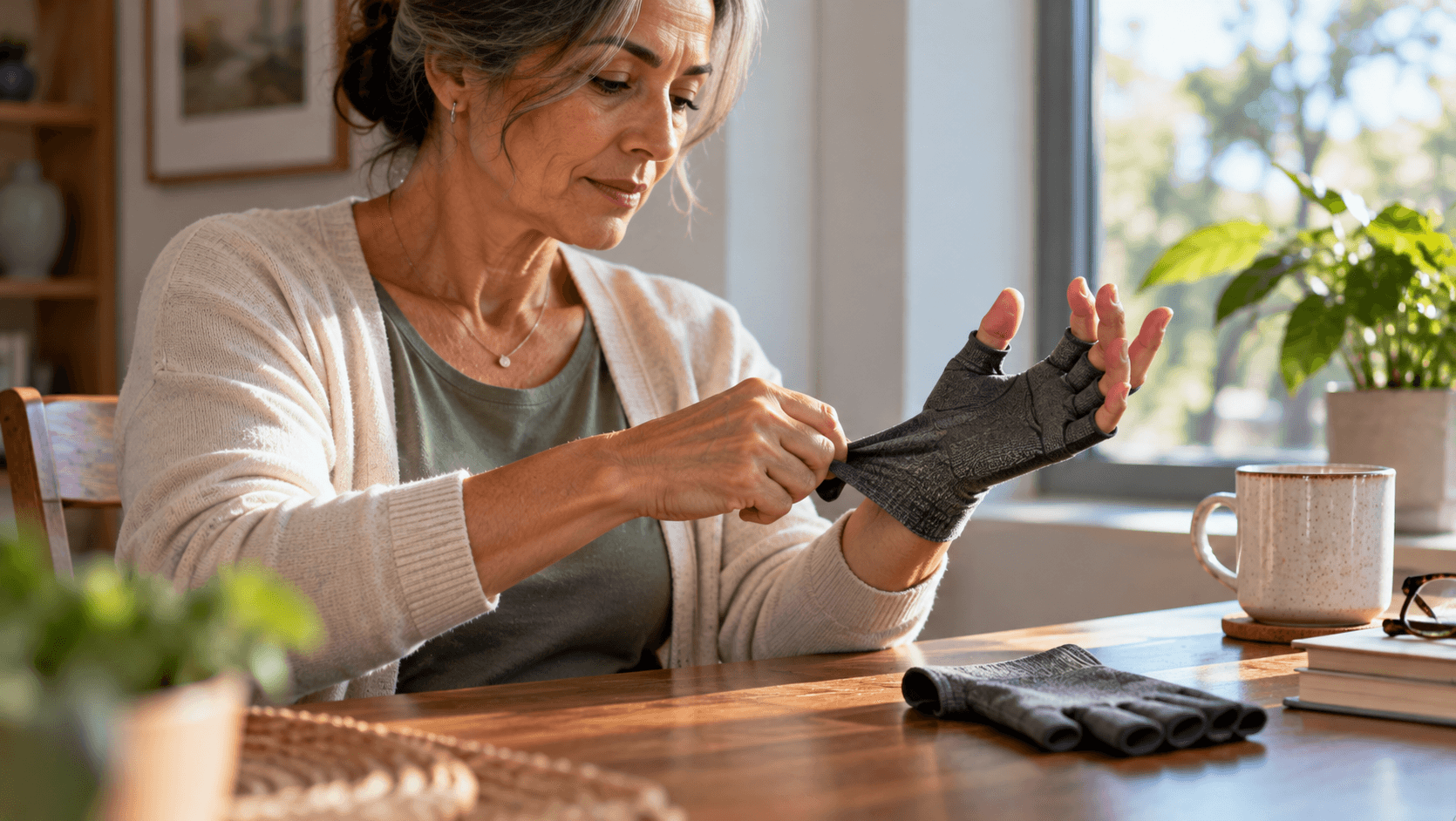
Arthritis gloves are often marketed as a simple way to ease hand pain, swelling, and stiffness. Some people like them because they add gentle compression and warmth. Others find them uncomfortable, too tight, or not helpful enough to keep using.
The key is to treat arthritis gloves as a comfort and support tool—not as a cure for arthritis, a replacement for hand exercises, or a reason to delay medical care. The right glove may make daily tasks feel easier for some people. The wrong glove, or wearing one for too long, can worsen numbness, skin irritation, swelling, or stiffness.
This guide explains when compression gloves may help, how they should fit, what to track, when to stop using them, and when hand symptoms need professional evaluation.
What Arthritis Gloves Are
Arthritis gloves are soft gloves designed to provide gentle compression, warmth, or both. Some cover the full fingers; others are fingerless. Some are thin enough for daytime tasks, while others are mainly used at rest or overnight.
They are commonly used by people with hand osteoarthritis, rheumatoid arthritis, inflammatory arthritis, swelling, stiffness, or hand discomfort. Versus Arthritis notes that some people find compression gloves helpful for reducing pain and swelling and that they may be easier to wear than some splints.
Gloves are not the same as braces, splints, ring splints, thumb orthoses, or medical compression garments prescribed for specific circulation or swelling problems. If your hand problem is complicated, a hand therapist can help choose the right support.
When Compression May Help
Arthritis gloves may help most when symptoms are mild to moderate and the goal is comfort during certain activities or rest periods.
- Morning stiffness in the fingers or hands
- Mild hand swelling that improves with gentle support
- Aching that feels better with warmth
- Hand discomfort during typing, reading, light chores, or rest
- Cold-sensitive hands that feel looser with warmth
- People who want a low-risk tool to try alongside exercises and medical care
The American College of Rheumatology and Arthritis Foundation osteoarthritis guideline says gloves may offer benefit for hand joints by providing warmth and compression, although evidence for many mechanical supports varies by joint and product.
When Gloves May Not Help Much
Arthritis gloves may not be enough when pain comes from a specific unstable joint, thumb-base arthritis, tendon problems, carpal tunnel syndrome, severe inflammation, nerve compression, infection, fracture, or a flare that needs medication adjustment.
- Sharp pain in one joint
- Severe swelling or warmth
- New numbness or tingling
- Loss of grip strength
- Finger locking or triggering
- Hand deformity that needs targeted support
- Symptoms that keep worsening despite self-care
A systematic review of compression gloves for rheumatoid arthritis and hand osteoarthritis found that evidence for night-time compression glove effectiveness was inconclusive. A randomized trial in rheumatoid arthritis also found no clinically important effect on hand pain, function, or stiffness.
How Compression Should Feel
Compression should feel gentle and evenly supportive. It should not feel like squeezing, throbbing, pinching, or cutting off circulation.
- Fingers should not turn blue, pale, purple, or unusually cold.
- There should be no new numbness or tingling.
- Rings should not feel trapped under the glove.
- The glove should not leave deep marks that last.
- You should still be able to move the fingers comfortably.
- Pain should not increase while wearing the glove.
If the glove feels too tight, remove it. Compression that worsens symptoms is not helpful compression.
Fit Checklist Before You Buy
Fit matters more than the label on the package. A glove that is too loose may not provide support. A glove that is too tight can cause pain, numbness, or swelling.
- Measure the hand according to the brand’s sizing instructions.
- Check whether the glove is full-finger or fingerless.
- Look for seams that do not rub painful joints.
- Choose breathable fabric if hands sweat.
- Make sure the wrist edge does not dig in.
- Confirm whether the glove is washable.
- Avoid wearing rings under gloves if swelling changes during the day.
Versus Arthritis advises getting advice from a health care professional, such as an occupational therapist, physiotherapist, or hand therapist, before buying a splint or hand support.
When to Wear Arthritis Gloves
The best time depends on the symptom pattern. Some people use gloves during morning stiffness. Some use them during desk work or light tasks. Some use them at night if advised and comfortable. Others use them only during flares.
- Morning: if stiffness is worst after waking
- During light tasks: if gentle compression improves comfort
- During rest: if warmth reduces aching
- At night: only if the glove stays comfortable and does not cause numbness or swelling
- During flares: only if compression does not worsen pain, heat, or swelling
Avoid wearing gloves continuously all day without breaks. Versus Arthritis warns that wearing splints all the time can increase joint stiffness and recommends gentle wrist, finger, and thumb exercises when the splint is removed.
When Not to Wear Them
There are times when compression can be risky or unhelpful.
- During severe swelling that makes the glove feel tight
- Over open wounds, sores, burns, rash, or infected skin
- When fingers are numb, tingling, blue, pale, or cold
- After a hand injury unless a clinician says compression is safe
- With new unexplained hand weakness
- When wearing the glove makes pain worse
If you have diabetes, neuropathy, circulation problems, Raynaud’s symptoms, skin fragility, severe swelling, or a history of hand surgery, ask a clinician before using compression gloves.
When to Stop Immediately
Stop using arthritis gloves right away if they cause warning signs.
- New numbness or tingling
- Fingers turning blue, purple, pale, or unusually cold
- Throbbing pain
- Worsening swelling above, below, or inside the glove
- Skin breakdown, blisters, rash, or sores
- Increased stiffness after wearing
- Weakness, dropping objects, or loss of coordination
Hand therapy advice for osteoarthritis commonly warns to stop exercises or supports if excessive pain, numbness, or tingling occurs. The same safety logic applies to compression gloves: discomfort that suggests nerve or circulation problems should not be ignored.
How Long to Try Them
A practical trial is usually enough to decide whether gloves are worth keeping in your routine. Try them at the same time of day for a short period, then compare symptoms.
- Try 30 to 60 minutes during a predictable symptom period.
- Check fingers for color, temperature, swelling, and sensation.
- Track whether pain, stiffness, or function improves.
- Increase wear time only if symptoms improve and no warning signs appear.
- Stop the trial if the glove causes numbness, tingling, pain, or swelling.
If there is no clear benefit after a fair trial, it is reasonable to stop. A glove does not need to be part of your plan just because it is marketed for arthritis.
What to Track
Tracking can help you decide whether gloves are actually helping.
- Pain before and after wearing
- Morning stiffness duration
- Finger swelling or ring tightness
- Grip tasks such as opening jars, typing, cooking, or dressing
- Numbness, tingling, or cold fingers
- Skin irritation or sweating
- How long the glove was worn
Bring this information to a clinician if you are unsure whether gloves, splints, exercises, medication changes, or hand therapy would be more appropriate.
Gloves vs Splints: What Is the Difference?
Compression gloves support the whole hand gently. Splints and orthoses are more targeted. They may limit movement, support a specific joint, or improve alignment during tasks or rest.
- Compression gloves: warmth and gentle support across the hand
- Thumb splints: support for thumb-base arthritis or instability
- Ring splints: support for finger joint alignment
- Wrist splints: support for wrist pain, carpal tunnel symptoms, or specific conditions
- Custom orthoses: made by a hand therapist for specific joint problems
The ACR/Arthritis Foundation guideline strongly recommends hand orthoses for first carpometacarpal joint osteoarthritis and conditionally recommends orthoses for other hand joints. Gloves may help some people through warmth and compression, but they are not a substitute for the correct orthosis when a specific joint needs support.
Gloves and Rheumatoid Arthritis
Rheumatoid arthritis, or RA, is an inflammatory autoimmune disease. Hand symptoms may include swelling, warmth, stiffness, pain, fatigue, and reduced function. Gloves may feel comforting for some people, but they do not control inflammation or prevent joint damage.
The 2022 American College of Rheumatology guideline for exercise, rehabilitation, diet, and integrative interventions in RA conditionally recommends splinting, orthoses, and/or compression for patients with hand or wrist involvement or deformity, and conditionally recommends hand therapy exercises for people with hand involvement.
If RA symptoms are worsening, gloves should not replace disease-modifying treatment, medication review, or rheumatology follow-up.
Gloves and Hand Osteoarthritis
Hand osteoarthritis often affects the thumb base, finger joints, or both. Symptoms may include aching, stiffness, bony enlargement, grip difficulty, and pain with pinching or opening objects.
Gloves may help with warmth and mild compression, but targeted thumb or finger supports may be more useful for certain joints. NICE advises against routinely offering supports for osteoarthritis unless they help a person move independently and safely by improving function or reducing weight bearing on the affected joint.
For hand osteoarthritis, a hand therapist can help match support to the task: jar opening, typing, gripping, lifting, cooking, writing, gardening, or sleep positioning.
Gloves Are Not a Replacement for Movement
Hands need gentle movement to reduce stiffness and maintain function. If gloves make you avoid moving the fingers, they may backfire.
- Open and close the fingers gently.
- Practice thumb-to-finger touches.
- Use warm water before gentle hand exercises if helpful.
- Take breaks from gripping tasks.
- Ask about hand therapy exercises if pain limits function.
NICE recommends considering a tailored strengthening and stretching hand exercise program for adults with rheumatoid arthritis who have hand or wrist pain and dysfunction.
When Warmth Helps More Than Compression
Some people are helped more by warmth than pressure. If compression feels uncomfortable but warmth feels good, consider other warming strategies.
- Warm water hand soak
- Warm towel
- Heated mitts used safely
- Warm gloves without compression
- Brief warm-up before hand exercises
Avoid heat if a joint is very hot, red, acutely swollen, infected, or newly injured unless a clinician says it is safe.
When Cold Helps More Than Compression
Cold may help some people during an acute flare, swelling episode, or after overuse. It should be used carefully to avoid skin injury.
- Use a cloth barrier between skin and cold pack.
- Use short sessions instead of prolonged cold exposure.
- Avoid cold if you have Raynaud’s symptoms, poor circulation, or reduced sensation unless advised.
- Stop if fingers become numb, painful, pale, or blue.
Compression gloves should not be used to force through a painful flare. Choose the strategy that matches the symptom and ask for guidance when unsure.
How to Use Gloves During Daily Tasks
Gloves are most useful when they make a task easier without causing new problems.
- Use them during light tasks that usually trigger aching.
- Avoid wearing them near open flames, sharp tools, or machinery if grip or fabric safety is a concern.
- Do not wear gloves if they reduce sensation enough to increase burn or injury risk.
- Remove them for skin checks and hand hygiene.
- Use adaptive tools for jars, pens, cooking, and dressing if grip is the main issue.
If a glove makes a task feel clumsier or less safe, stop using it for that task.
Common Mistake: Wearing Gloves Too Tight
More compression is not always better. Tight gloves can worsen swelling, numbness, tingling, pain, or skin irritation.
Choose gentle, even compression.
Remove the glove if your fingers change color, temperature, or sensation.
Common Mistake: Wearing Gloves All Day Without Breaks
Constant wear can make it harder to notice skin changes, swelling, or stiffness.
Take breaks.
Move the fingers gently when the gloves come off.
Common Mistake: Using Gloves Instead of Treating Inflammation
Inflammatory arthritis may need medication adjustment, lab monitoring, imaging, or rheumatology care. Gloves may feel comforting, but they do not treat the immune inflammation driving RA.
Call the care team if swelling, warmth, morning stiffness, fatigue, or function is worsening.
Do not delay treatment because gloves provide partial relief.
Common Mistake: Ignoring Numbness or Tingling
Numbness or tingling may mean the glove is too tight, but it can also point to carpal tunnel syndrome, neuropathy, nerve compression, circulation problems, or another condition.
Stop the glove if symptoms appear while wearing it.
Ask for evaluation if symptoms persist after removal.
Common Mistake: Expecting Gloves to Fix Grip Strength
Gloves may improve comfort, but they do not rebuild strength by themselves.
Ask about hand exercises, adaptive tools, and hand therapy.
Track real tasks, not only pain scores.
When to Talk to a Clinician
Talk to a clinician, rheumatologist, occupational therapist, physical therapist, or certified hand therapist if hand pain, swelling, stiffness, weakness, numbness, tingling, deformity, or loss of function is new, worsening, or interfering with daily tasks.
You should also seek guidance before using compression gloves if you have diabetes, neuropathy, circulation problems, Raynaud’s symptoms, severe swelling, skin fragility, open wounds, recent hand surgery, recent injury, unexplained weakness, or symptoms that affect only one hand suddenly.
A clinician may recommend hand exercises, medication review, imaging, lab testing, targeted splints, thumb orthoses, ring splints, adaptive tools, topical medicines, injections, rheumatology care, hand therapy, or a different diagnosis depending on the pattern.
When to Seek Urgent or Emergency Care
Seek urgent care for a hot, red, severely swollen joint; fever with joint pain; sudden severe hand pain; new deformity after injury; signs of infection; spreading redness; pus; severe weakness; or sudden numbness that does not improve after removing the glove.
Seek emergency care for sudden one-sided weakness or numbness, facial drooping, speech trouble, chest pain, severe shortness of breath, or symptoms that feel life-threatening.
Do not keep wearing a compression glove if the hand becomes blue, pale, cold, numb, severely painful, or swollen. Remove it and seek medical advice promptly.
The Bottom Line
Arthritis gloves may help some people with hand pain, stiffness, or mild swelling by adding warmth and gentle compression. They are most useful as a comfort tool within a broader plan that may include hand exercises, medication review, joint protection, adaptive tools, splints, hand therapy, and medical follow-up.
Compression should feel gentle, not tight. Stop using gloves if they cause numbness, tingling, color change, cold fingers, throbbing pain, worsening swelling, skin irritation, weakness, or increased stiffness.
The most common mistakes are wearing gloves too tight, wearing them all day without breaks, using them instead of treating inflammation, ignoring numbness or tingling, and expecting gloves to fix grip strength by themselves.
Use gloves only if they improve comfort or function without new problems. If hand symptoms are changing, severe, inflammatory, or affecting daily life, ask for a targeted hand evaluation.
Medical disclaimer: This content is for informational purposes only and is not a substitute for professional medical advice, arthritis diagnosis, rheumatology care, hand therapy, medication management, splint fitting, circulation evaluation, nerve testing, infection care, injury evaluation, or emergency care. Always consult your physician, rheumatologist, occupational therapist, physical therapist, certified hand therapist, pharmacist, or qualified health provider before using compression gloves if you have diabetes, neuropathy, circulation problems, Raynaud’s symptoms, severe swelling, open wounds, skin problems, recent injury, recent surgery, numbness, weakness, or worsening symptoms. If your hand becomes blue, pale, cold, numb, severely painful, infected, suddenly weak, or severely swollen, or if you have stroke symptoms, chest pain, severe shortness of breath, or another emergency, seek urgent medical care right away.