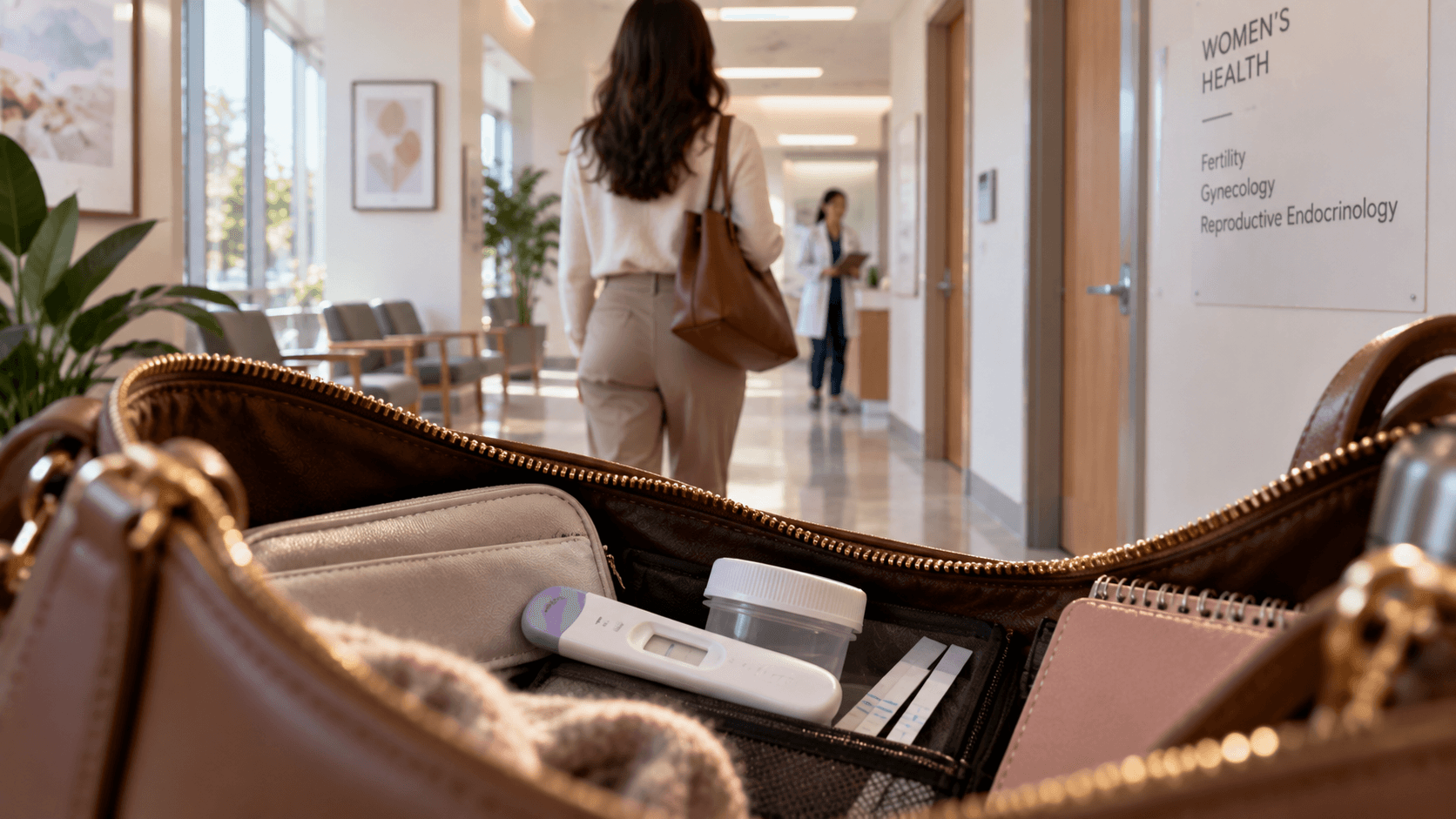
At-home reproductive health tests can help some people understand cycle timing, ovulation patterns, and when to take a pregnancy test. They may be useful for planning intercourse, organizing questions for a clinician, or noticing when cycles are irregular. But they cannot diagnose all causes of female infertility, and a normal result does not guarantee fertility.
Female infertility can involve ovulation, fallopian tubes, the uterus, endometriosis, age-related fertility changes, thyroid or prolactin problems, PCOS, partner sperm factors, recurrent pregnancy loss, or unexplained infertility. At-home tests usually look at one narrow piece of the picture.
This guide explains common at-home reproductive health tests, what accuracy depends on, when timing matters, what results mean, and when to follow up with an ob-gyn, reproductive endocrinologist, fertility clinic, or other qualified clinician.
Start With What At-Home Tests Can and Cannot Answer
At-home fertility tests can answer practical questions such as “Am I near an LH surge?” or “Is a pregnancy hormone detectable yet?” They usually cannot answer broader questions such as whether fallopian tubes are open, whether sperm parameters are normal, whether the uterine cavity is healthy, whether endometriosis is present, or whether a person will conceive naturally.
ACOG states that experts recommend an infertility evaluation if pregnancy has not occurred after 1 year of regular intercourse without birth control. Evaluation may happen sooner based on age, medical history, irregular cycles, known reproductive conditions, or other risk factors.
ASRM also emphasizes that infertility evaluation should be systematic, expeditious, and cost-effective, with attention to the most common causes first.
Test Type 1: Ovulation Predictor Kits
Ovulation predictor kits, often called OPKs, usually test urine for luteinizing hormone, or LH. LH rises before ovulation. A positive result can help identify the fertile window.
- Useful for timing intercourse or insemination attempts
- Most helpful when cycles are fairly predictable
- Less helpful when periods are very irregular or LH is persistently elevated
- Does not prove that ovulation definitely happened
The FDA explains that home ovulation urine tests detect LH in urine to help predict ovulation, but they should not be used to prevent pregnancy because they are not reliable for that purpose. The FDA also notes that doctors may use other tests and medical history to get a better view of fertility status.
Timing Ovulation Tests Correctly
Timing matters. If testing starts too late, the LH surge may be missed. If testing starts too early, the person may use many tests before the fertile window.
- Follow the test instructions for when to start based on cycle length.
- Test at a consistent time of day if the instructions recommend it.
- Avoid drinking large amounts of fluid right before testing if the instructions warn against diluted urine.
- Record the first positive result and the following 1 to 2 days as high-priority timing days if trying to conceive.
Mayo Clinic Press notes that over-the-counter ovulation kits test urine for the LH surge that starts about 36 hours before ovulation.
Accuracy Limits of Ovulation Tests
Ovulation tests can be useful, but false positives, missed surges, and confusing patterns can happen.
- Some people have short LH surges that are easy to miss.
- PCOS or irregular cycles may make results harder to interpret.
- Some fertility medications can affect test results.
- A positive LH test predicts ovulation; it does not confirm that the egg was released.
- A negative test does not rule out ovulation if testing timing was wrong.
If OPKs are repeatedly positive, never positive, or confusing across several cycles, bring the results to a clinician instead of buying more tests indefinitely.
Test Type 2: Saliva Ovulation Tests
Saliva ovulation tests look for patterns that may change around ovulation. They may be reusable, but they can be more subjective than urine LH testing.
- May be affected by technique, timing, food, drink, or interpretation
- May be difficult for beginners to read consistently
- Does not diagnose infertility
- Should not be used as a birth control method
The FDA describes saliva ovulation kits as home-use tests that try to predict ovulation by looking at patterns formed by saliva. The FDA states they should not be used to help prevent pregnancy because they are not reliable for that purpose.
Test Type 3: Pregnancy Tests
Home pregnancy tests measure human chorionic gonadotropin, or hCG, in urine. They are most useful after ovulation has occurred and enough time has passed for hCG to rise.
- Useful after a missed period or after the test’s recommended earliest testing window
- More reliable when used exactly as directed
- Can be falsely negative if taken too early
- Should be followed up if positive, unclear, or paired with concerning symptoms
The FDA explains that home pregnancy tests measure hCG in urine and, in a 28-day cycle, hCG can be detected in urine about 12 to 15 days after ovulation.
Accuracy Limits of Pregnancy Tests
A negative pregnancy test does not always mean you are not pregnant. Testing too early is a common reason for a false negative.
- Repeat testing if the period does not arrive.
- Use first-morning urine if the instructions recommend it.
- Check the expiration date.
- Read the result within the instructed time window.
- Call a clinician for positive tests with pain, heavy bleeding, dizziness, or fainting.
Seek urgent care for severe pelvic pain, shoulder pain, fainting, dizziness, or heavy bleeding with a positive pregnancy test or possible pregnancy, because ectopic pregnancy and other urgent conditions need prompt care.
Test Type 4: FSH Tests
Some at-home fertility tests measure follicle-stimulating hormone, or FSH, usually in urine. FSH may rise when ovarian response is reduced, but a single home FSH test is not the same as a full infertility evaluation.
- May be marketed as an ovarian reserve or menopause-related test
- Timing in the menstrual cycle matters
- Results can vary by cycle and test method
- Does not show whether tubes are open, ovulation is consistent, or sperm factors are normal
ACOG lists ovarian reserve testing as one possible part of infertility evaluation, along with other tests based on history and prior results.
Test Type 5: AMH Tests
Anti-Müllerian hormone, or AMH, is often used in fertility clinics as one marker of ovarian reserve, especially when planning fertility treatment. Some direct-to-consumer or home-collected tests include AMH.
- AMH may help estimate ovarian response to stimulation in fertility treatment.
- AMH does not diagnose all causes of infertility.
- AMH does not guarantee whether you can or cannot get pregnant naturally.
- Results should be interpreted with age, history, ultrasound findings, and the full clinical picture.
ASRM states that ovarian reserve testing should not be used as a screening test for women who do not meet infertility criteria, and should serve as an adjunct to infertility evaluation. ASRM also states that ovarian reserve tests should be interpreted in the context of the entire clinical picture.
Accuracy Limits of AMH and Ovarian Reserve Testing
Ovarian reserve tests are often misunderstood. A low AMH or abnormal FSH result may be important, but it does not automatically mean natural pregnancy is impossible. A normal result does not guarantee easy conception.
ASRM’s committee opinion on ovarian reserve testing states that markers of ovarian reserve should not be used as a fertility test for women who are not infertile or who have untested fertility. It also states that these tests should not be used to deny access to infertility treatment.
- AMH is not a direct count of remaining eggs.
- FSH and AMH do not test egg quality directly.
- Age remains one of the most important fertility factors.
- Ovarian reserve testing does not evaluate sperm, tubes, uterus, or endometriosis.
Test Type 6: Cycle-Tracking Apps and Wearables
Apps and wearables may estimate fertile windows using cycle dates, temperature, heart rate, sleep, or other signals. These can help organize data, but predictions can be wrong.
- Useful for logging period dates, symptoms, ovulation tests, and intercourse timing
- Less reliable when cycles are irregular or data is incomplete
- May not account for illness, stress, travel, postpartum changes, or medication effects
- Should not be treated as a diagnosis or a guarantee of ovulation
ACOG explains that fertility awareness methods use body temperature and other signs and symptoms of ovulation, but these methods require careful tracking and have limitations.
Test Type 7: Basal Body Temperature
Basal body temperature, or BBT, can rise after ovulation because progesterone increases. This means BBT may help confirm that ovulation likely happened, but it usually does not predict ovulation early enough to time intercourse for that same cycle.
- Measure at the same time each morning before getting out of bed.
- Use a thermometer designed for small temperature changes.
- Track patterns over several cycles.
- Note fever, poor sleep, alcohol, travel, or schedule changes.
ACOG’s infertility evaluation resource notes that basal body temperature can be tracked at home, while progesterone blood testing about 1 week before the expected period can help evaluate ovulation.
Test Type 8: Home-Collected Lab Panels
Some companies offer home-collected blood spot, saliva, or urine panels for hormones such as AMH, FSH, LH, estradiol, thyroid-stimulating hormone, prolactin, or progesterone. These tests may be convenient, but interpretation still matters.
- Check whether the test uses a certified laboratory.
- Confirm whether results are reviewed by a clinician.
- Follow collection timing exactly.
- Ask what abnormal results should trigger follow-up.
- Do not start or stop medication based only on a direct-to-consumer result.
The FDA explains that direct-to-consumer tests for moderate- to high-risk medical purposes are generally reviewed to determine whether test claims are analytically valid, clinically valid, and appropriate for consumer use without a health care provider.
What At-Home Tests Often Miss
Female infertility evaluation usually requires more than at-home hormone and ovulation data.
- Fallopian tube blockage
- Uterine polyps, fibroids, adhesions, or congenital uterine differences
- Endometriosis
- Pelvic inflammatory disease history or tubal scarring
- Sperm count, motility, morphology, or ejaculation concerns
- Thyroid, prolactin, PCOS, or other hormonal conditions requiring clinical interpretation
- Recurrent pregnancy loss evaluation
Mayo Clinic notes that female infertility diagnosis may include ovulation testing, hormone testing, ovarian reserve testing, imaging, and tests to see if the fallopian tubes are open.
When Timing Matters Most
Timing is one of the biggest reasons at-home reproductive tests are misread.
- Ovulation tests must be used before the expected fertile window, not after it has passed.
- Pregnancy tests are more reliable after enough time has passed after ovulation.
- FSH tests may need specific cycle-day timing.
- Progesterone testing is usually timed after ovulation, often about 1 week before the expected period when ordered clinically.
- Cycle apps become less reliable when periods are irregular.
If cycles are very irregular, absent, shorter than usual, longer than usual, or unpredictable, ask whether at-home timing methods are worth continuing or whether clinical testing should come first.
Buying Checklist: Ovulation and Pregnancy Tests
Before buying, compare practical features that affect correct use.
- Clear instructions and result window
- Expiration date
- Easy-to-read display or line comparison
- Enough test strips for your cycle pattern
- Instructions about urine timing and fluid intake
- Customer support or digital reader if line interpretation is difficult
Do not use ovulation tests to prevent pregnancy. The FDA specifically warns that home ovulation tests are not reliable for that purpose.
Buying Checklist: Hormone and Ovarian Reserve Tests
Before buying a hormone panel or ovarian reserve test, ask whether the result will change your next step.
- Which hormone is being measured?
- Is it urine, saliva, blood spot, or venous blood?
- What cycle day or timing is required?
- Is the lab certified and clearly identified?
- Is clinician review included?
- Does the report explain limits clearly?
- Does it avoid claims that one result predicts whether you can get pregnant?
If you already meet criteria for infertility evaluation, spending more cycles on at-home testing may delay more useful clinical assessment.
How to Organize Results for Follow-Up
Bring a short, organized summary rather than a pile of screenshots.
- Cycle start dates for the last 3 to 6 months
- Cycle length and whether bleeding is heavy, painful, or irregular
- Ovulation test dates and positive results
- Pregnancy test dates and results
- Home hormone test results with date, cycle day, and lab method if listed
- Intercourse or insemination timing if relevant and comfortable to share
- Symptoms such as pelvic pain, severe cramps, acne, hair growth, hot flashes, nipple discharge, or weight changes
This information can help your clinician decide whether to evaluate ovulation, ovarian reserve, tubes, uterus, endocrine factors, partner factors, or other causes.
Common Mistake: Treating a Positive OPK as Proof of Ovulation
A positive ovulation predictor kit shows an LH surge. It does not prove that ovulation definitely happened.
If cycles are irregular, OPKs are confusing, or pregnancy has not occurred after the recommended time frame, ask whether progesterone testing, ultrasound tracking, or a broader evaluation is needed.
Do not keep repeating OPKs for many months if the results are not helping decisions.
Common Mistake: Treating AMH as a Fertility Score
AMH is often marketed in a way that can sound like a direct fertility score. It is not that simple.
AMH may help fertility clinicians estimate ovarian response to treatment, but it does not test every part of fertility and does not guarantee natural pregnancy outcomes.
Use AMH as one piece of clinical context, not a final verdict.
Common Mistake: Testing Too Early for Pregnancy
Testing too early can create unnecessary confusion and disappointment.
Follow the test instructions and repeat if the period does not arrive.
Call a clinician for positive tests with severe pain, heavy bleeding, dizziness, or fainting.
Common Mistake: Ignoring the Partner Side
Infertility evaluation should consider both partners when relevant. At-home female fertility tests do not evaluate semen analysis, ejaculation concerns, prior testicular injury, varicocele, medications, or other male-factor contributors.
ACOG notes that infertility can affect both men and women and that the male partner’s medical history and semen analysis are part of evaluation.
Do not assume a normal ovulation or hormone result means the only issue has been solved.
Common Mistake: Delaying Care Because Tests Look Normal
Normal at-home results do not rule out tubal disease, endometriosis, uterine conditions, sperm factors, recurrent pregnancy loss issues, or unexplained infertility.
If you meet criteria for evaluation, schedule the appointment even if your tests look normal.
Bring the results as supporting information, not as a replacement for care.
When to Talk to a Clinician
Talk to a clinician if you have not become pregnant after 12 months of regular intercourse without birth control, or sooner if you are 35 or older, have irregular or absent periods, known endometriosis, PCOS, pelvic inflammatory disease, prior pelvic surgery, recurrent pregnancy loss, chemotherapy or radiation exposure, severe pelvic pain, or a known partner fertility concern.
Seek guidance sooner if at-home tests are confusing, repeatedly abnormal, or causing distress, or if results may affect decisions about egg freezing, IVF, donor eggs, donor sperm, or fertility medications.
A clinician may recommend ovulation evaluation, hormone testing, ultrasound, ovarian reserve testing, tubal evaluation, uterine cavity evaluation, semen analysis, genetic testing when appropriate, lifestyle review, medication review, or referral to a reproductive endocrinologist.
When to Seek Urgent or Emergency Care
Seek urgent or emergency care for severe pelvic or abdominal pain, shoulder pain, fainting, severe dizziness, heavy vaginal bleeding, fever with pelvic pain, positive pregnancy test with one-sided pain, or symptoms that feel dangerous.
Seek prompt care for possible ectopic pregnancy symptoms, ovarian torsion symptoms, severe infection symptoms, or heavy bleeding that soaks pads rapidly.
Do not wait for a fertility appointment if pain, bleeding, fainting, or pregnancy-related warning signs could be urgent.
The Bottom Line
At-home reproductive health tests can help with timing, cycle awareness, ovulation prediction, and pregnancy testing. Ovulation predictor kits may help identify the fertile window. Pregnancy tests can detect hCG after enough time has passed. Some hormone panels may provide information to discuss with a clinician.
The limits are important. A positive OPK does not prove ovulation. AMH and FSH are not stand-alone fertility scores. A normal at-home test does not rule out tubal, uterine, endometriosis, sperm, endocrine, or unexplained causes of infertility.
The most common mistakes are treating a positive OPK as proof of ovulation, treating AMH as a fertility score, testing too early for pregnancy, ignoring the partner side, and delaying care because tests look normal.
Use at-home tests to organize information and make follow-up more productive. If you meet criteria for infertility evaluation or have risk factors, schedule clinical care instead of relying on more at-home testing.
Medical disclaimer: This content is for informational purposes only and is not a substitute for professional medical advice, diagnosis, infertility evaluation, fertility treatment, hormone interpretation, pregnancy care, genetic counseling, reproductive endocrinology care, or emergency care. Always consult your physician, ob-gyn, reproductive endocrinologist, fertility specialist, pharmacist, genetic counselor, or qualified health provider. If you have severe pelvic pain, heavy bleeding, fainting, severe dizziness, fever with pelvic pain, positive pregnancy test with one-sided pain, shoulder pain, or another emergency, seek urgent medical care right away.