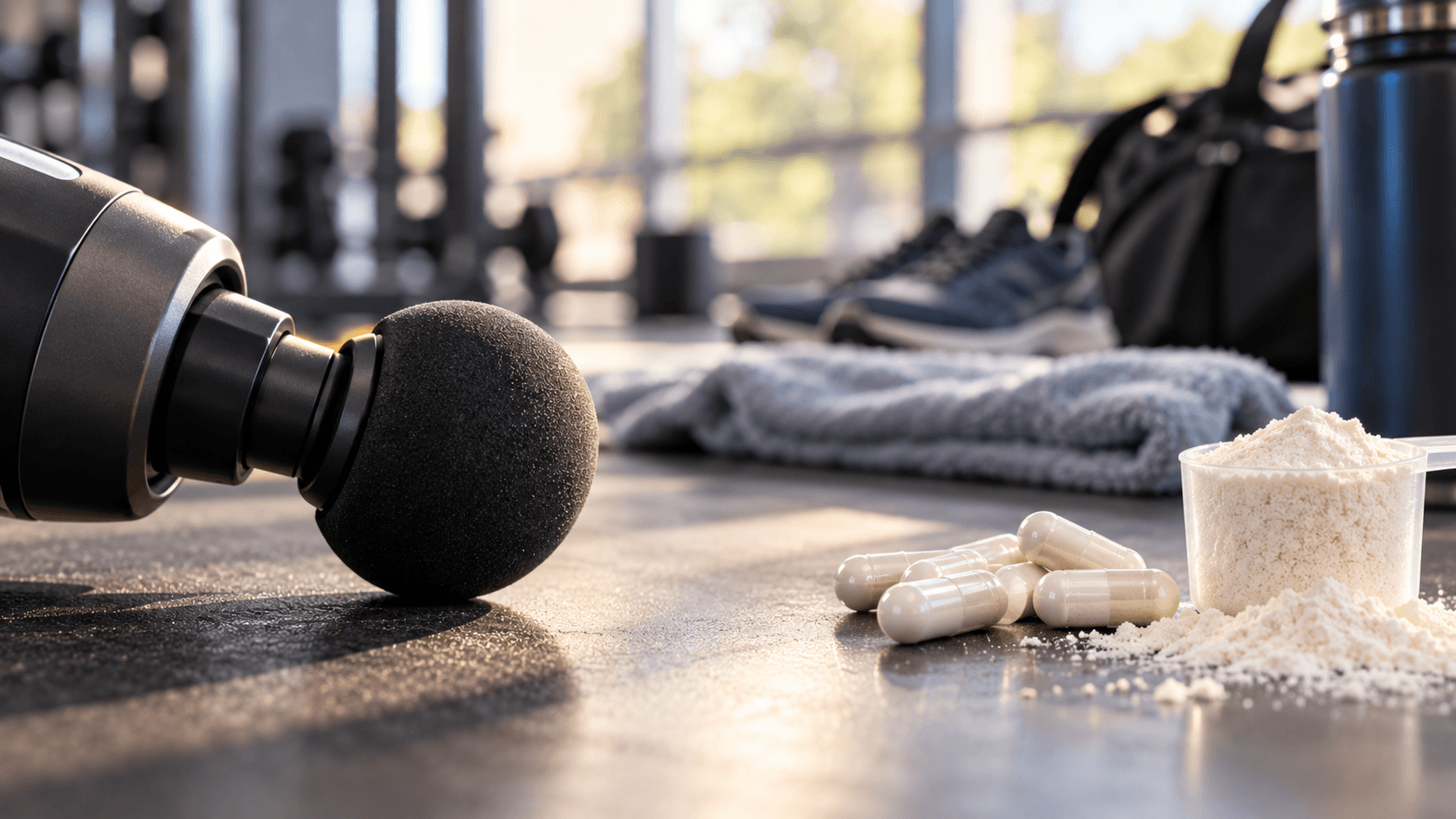
Walk through any sporting goods store or scroll a fitness feed for more than thirty seconds and you will almost certainly encounter two things: a percussion massager with promises of faster recovery, and a tub of L-glutamine powder marketed to hard-training athletes. Together, these two products represent a large slice of the consumer recovery market. But how well do they actually work—and for whom?
This article breaks down the evidence on both tools, explains the difference between everyday muscle soreness and the more serious pattern called overtraining syndrome, and helps you ask smarter questions before reaching for your wallet.
Understanding Recovery and Overtraining
Your muscles adapt and grow stronger during rest, not during exercise itself. When you train hard, you create small amounts of mechanical stress and metabolic byproducts in muscle tissue. Given adequate sleep, nutrition, and time, that tissue rebuilds slightly stronger than before. This is called progressive overload, and it is the engine behind every fitness gain.
Trouble starts when the balance tips too far toward stress and not far enough toward recovery. Overtraining syndrome is a recognized clinical condition characterized by prolonged declines in performance, persistent fatigue, mood disturbances, disrupted sleep, and sometimes hormonal changes—even when training volume drops. It is distinct from ordinary muscle soreness (called delayed-onset muscle soreness, or DOMS), which peaks within a day or two after an unfamiliar or intense workout and resolves on its own.
True overtraining syndrome is less common than marketing implies, but the milder pattern of functional overreaching—where performance temporarily stalls and fatigue accumulates—is something many regular exercisers experience. Recovery tools and supplements are most often used for this everyday wear-and-tear, not for true clinical overtraining, which warrants a conversation with a physician or sports medicine specialist.
Electric Massagers: Percussion Devices, Foam Rollers, and Beyond
Electric percussion massagers—sometimes called massage guns—deliver rapid, repetitive pulses of pressure deep into muscle tissue. Vibrating foam rollers and handheld electric devices work on a related principle. The proposed mechanisms include increasing local blood flow, reducing muscle stiffness, and dampening the perception of pain through nerve stimulation.
What Research Suggests About Electric Massagers
The evidence base for percussion and vibration devices has grown in recent years, though it remains a relatively young field. Here is a fair summary of where things stand:
- Reduced perception of soreness. Several small randomized trials and systematic reviews suggest that vibration therapy and percussion massage can modestly reduce the feeling of soreness in the hours and days following intense exercise. Whether this translates to faster actual tissue repair is less clear.
- Improved short-term range of motion. Research on foam rolling and vibration consistently finds acute improvements in flexibility and joint range of motion, which may help athletes warm up more effectively or feel less stiff after training.
- Limited effect on strength recovery. The evidence that massage devices meaningfully speed the recovery of muscle strength or power output is weaker. Some studies show a small benefit; others show little difference compared with passive rest.
- Neurological comfort effects. Part of what these devices may be doing is stimulating sensory receptors in a way that simply makes muscles feel better—a real benefit for comfort and adherence to training, even if the underlying biology is still being studied.
In practical terms, if an electric massager helps you feel better, move more freely, and stay consistent with your training, that has genuine value. Just don't expect it to erase the effects of chronically inadequate sleep or poor nutrition—no device can do that.
Safety and Smart Use of Electric Massagers
Percussion devices are generally safe for healthy adults when used according to manufacturer guidelines. A few common-sense cautions:
- Avoid using them directly over bones, joints, nerves, or areas of acute injury, swelling, or bruising.
- People with circulatory conditions, blood clots, neuropathy, or recent surgery should check with a clinician before use.
- More pressure and longer sessions are not always better—soreness that worsens after device use is a signal to back off.
- High-end devices are not necessarily more effective than mid-range ones for everyday recovery needs; features matter more than brand prestige.
L-Glutamine: The Supplement Aisle's Recovery Staple
L-glutamine is a conditionally essential amino acid, meaning your body can usually make enough of it on its own—but under significant physiological stress, demand can outpace supply. It is the most abundant amino acid in human blood and muscle tissue, and it plays important roles in immune function, gut health, and protein synthesis.
Because intense exercise temporarily lowers circulating glutamine levels, the idea emerged that supplementing with it might help athletes recover faster, preserve muscle mass, and support immune health during heavy training blocks. Those claims deserve a careful look.
What Research Suggests About L-Glutamine
- Immune support during very heavy training. Some research—particularly in endurance athletes training at high volumes—suggests that glutamine supplementation may help support immune markers that dip after prolonged intense exercise. This does not mean it prevents illness in the average gym-goer training a few times per week.
- Gut integrity. L-glutamine is a primary fuel source for the cells lining the intestinal wall. Clinical research supports its use in certain medical contexts involving gut barrier stress. Whether this benefit applies to recreational athletes is not firmly established.
- Muscle soreness and recovery. Studies examining glutamine's effect on DOMS and muscle recovery in resistance-trained individuals show mixed results. Some find modest reductions in soreness markers; others find no meaningful difference compared with placebo.
- Muscle mass preservation. The hope that glutamine supplements preserve or build muscle in healthy athletes training with adequate protein has not been strongly supported by controlled research. When total dietary protein intake is sufficient, extra glutamine appears to offer little additional muscle-building benefit.
Key context: Many athletes who train hard and eat a varied diet with adequate protein already consume meaningful amounts of glutamine through food—meat, fish, eggs, dairy, and some plant proteins are all sources. Supplementation stacks on top of this existing intake.
Who Might Benefit Most from L-Glutamine?
The people for whom L-glutamine supplementation has the clearest potential signal are those under unusually high physiological stress: elite endurance athletes with very high training volumes, individuals recovering from illness or surgery (in medically supervised contexts), or people with compromised gut health. For the recreational athlete doing moderate strength or cardio training and eating a protein-adequate diet, the case for spending money on glutamine powder is less compelling.
Safety Considerations for L-Glutamine
L-glutamine is generally regarded as safe for healthy adults at commonly sold doses. A few things worth knowing:
- People with kidney or liver conditions, epilepsy, or certain metabolic disorders should consult a doctor before supplementing with any amino acid, including glutamine.
- Supplements are not regulated the same way medications are. Look for products that have been third-party tested for purity and label accuracy.
- More is not necessarily better—very high doses have not been shown to produce proportionally greater benefits in healthy people.
Combining Both: Does Pairing Them Make Sense?
There is nothing inherently problematic about using both an electric massager and an L-glutamine supplement. They act through different mechanisms—one mechanical and sensory, one nutritional and biochemical—so they are not redundant. That said, stacking two modestly evidenced tools does not multiply their effects. If budget is a concern, prioritize what the research consistently shows matters most for recovery: adequate sleep, sufficient dietary protein, appropriate training load, and stress management. Recovery tools and supplements work best as additions to that foundation, not substitutes for it.
Red Flags That Go Beyond Normal Soreness
No massager or supplement should substitute for medical attention if you are experiencing signs of overtraining syndrome or something more serious. Talk to a clinician if you notice:
- Performance that keeps declining despite reduced training and rest
- Persistent fatigue that does not improve with sleep
- Significant mood changes, anxiety, or depression tied to training
- Frequent illness or infections
- Sleep disturbances that seem out of proportion to your lifestyle
- Unexplained pain, joint swelling, or injury
A sports medicine physician or a registered dietitian with sports nutrition expertise can help you figure out whether a recovery product is filling a real gap or whether something else needs attention.
The Bottom Line
Electric percussion massagers have reasonable evidence for reducing perceived soreness and improving short-term mobility, making them a legitimate comfort tool for many athletes. L-glutamine supplements have a clearer rationale for people under very high physiological stress but offer less obvious benefit for the average recreational exerciser eating enough protein. Neither product is a scam, and neither is a miracle. They are incremental tools that work best in the context of smart training, good nutrition, and prioritized rest.
Before you buy, ask yourself: Is this filling a real gap in my recovery, or am I looking for a shortcut around the basics? If you are unsure whether either product is appropriate for your health situation, a sports medicine clinician or registered dietitian is your best next stop.