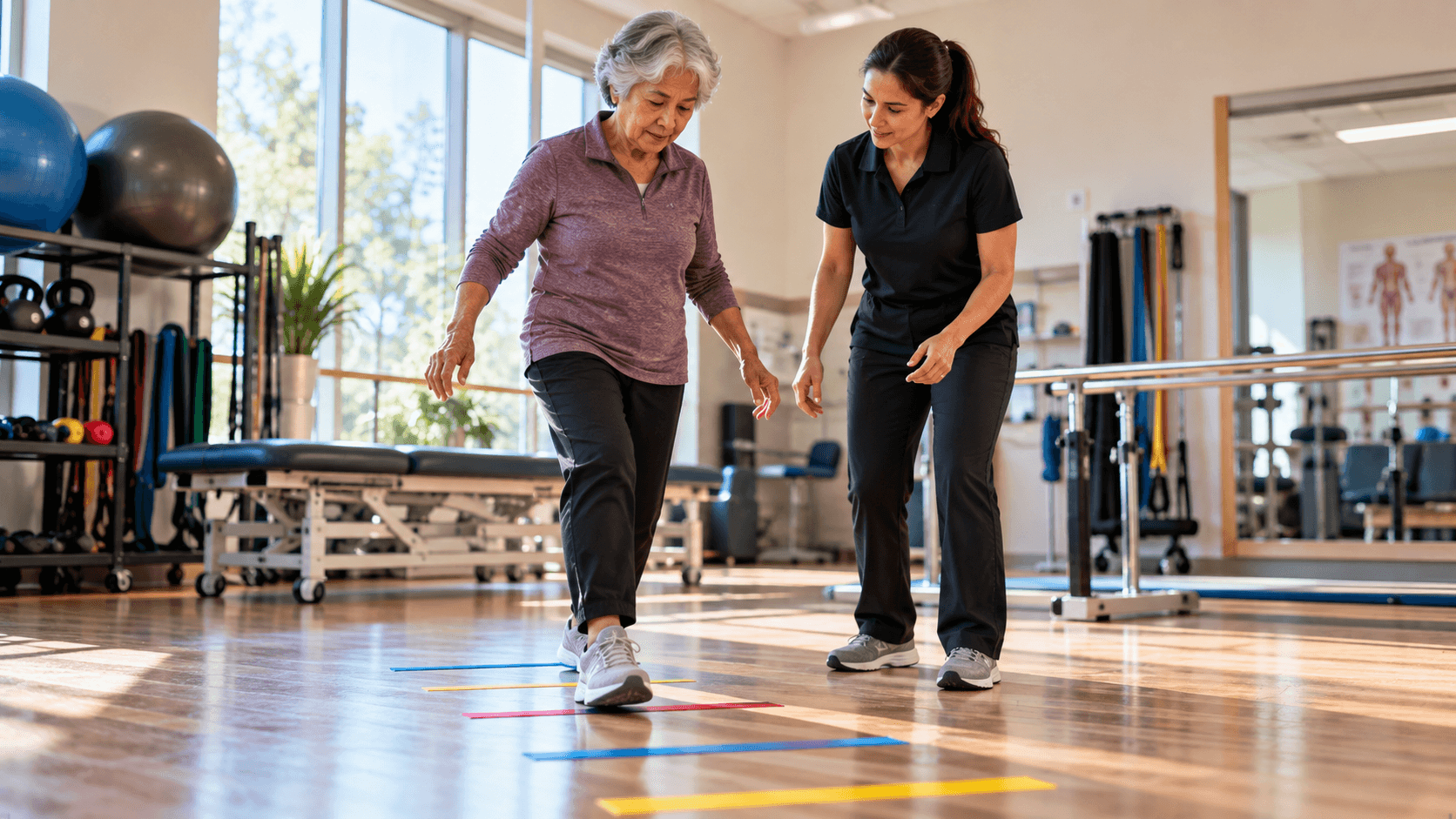
Exercise is an important part of living well with Parkinson's disease. While medication can help manage symptoms, regular movement can support balance, strength, walking, flexibility, and confidence during everyday activities. The challenge is that Parkinson's can make the very movements that exercise is meant to improve more difficult.
Someone may take smaller steps, feel unsteady when turning, struggle to stand from a chair, or experience moments when their feet seem stuck to the floor. These changes can make ordinary exercise advice difficult to follow. A generic recommendation to "walk more" may not address the specific movement problems that increase fall risk.
A more useful approach combines several types of exercise with practical movement strategies. Strength training helps support daily tasks. Balance training improves stability. Gait practice works on walking patterns. Cueing strategies use sound, visual markers, or intentional movement instructions to help initiate or maintain movement.
This guide explains how these approaches fit together, what exercises may help, how to practice safely, and when to involve a physical therapist who specializes in Parkinson's disease.
Why Exercise Matters in Parkinson's Disease
Parkinson's disease affects brain networks involved in movement control. Common movement symptoms include slowness, stiffness, resting tremor, and impaired balance. Walking may become slower, steps may shorten, and changing direction may require more concentration.
Exercise does not cure Parkinson's or replace medication. However, research supports structured physical activity for improving mobility, balance, walking, physical function, and quality of life.
The American Physical Therapy Association's clinical practice guideline recommends aerobic exercise, resistance training, balance training, gait training, and external cueing for appropriate people with Parkinson's disease.
Exercise may also support sleep, mood, cardiovascular fitness, and confidence. Its benefits depend on the person's abilities, symptoms, exercise consistency, and safety needs.
The Four Main Components of a Parkinson's Exercise Plan
The Parkinson's Foundation and the American College of Sports Medicine recommend a well-rounded exercise program that includes four major components.
- Aerobic activity: supports endurance and cardiovascular fitness.
- Strength training: helps maintain muscle strength and functional movement.
- Balance, agility, and multitasking: develops stability and coordination during everyday activities.
- Flexibility: addresses stiffness and supports movement through a comfortable range.
The Parkinson's Foundation recommends working toward approximately 150 minutes of moderate-to-vigorous exercise per week when appropriate, with activities adapted to individual ability and safety. This is a general goal, not a requirement to reach immediately.
A person who has been inactive or has substantial balance difficulties may need to start with shorter, supervised sessions.
Start With a Parkinson's-Specific Movement Assessment
Before beginning a new exercise program, consider an evaluation with a physical therapist experienced in Parkinson's disease.
Such an assessment may look at:
- Walking speed and step length
- Balance when standing and turning
- History of falls or near-falls
- Leg and trunk strength
- Difficulty getting out of chairs or bed
- Freezing of gait
- Posture and flexibility
- Medication-related movement changes
- Blood pressure changes with standing
- Other health conditions affecting exercise safety
The Parkinson's Foundation recommends early physical therapy involvement to identify movement problems and design an individualized exercise plan.
The assessment can also help determine which exercises are appropriate independently and which require supervision.
Balance Training: More Than Standing on One Leg
Balance involves vision, sensation, muscle strength, reflexes, attention, and the brain's ability to coordinate movement. Parkinson's can interfere with several of these systems.
Balance training should focus on situations that matter in daily life, such as standing from a chair, stepping around objects, turning, reaching, and walking through narrow spaces.
The APTA guideline strongly recommends balance training to improve postural control, walking, mobility, balance confidence, and quality of life.
Exercise 1: Supported Weight Shifting
Weight shifting helps practice transferring body weight from one leg to the other, a movement required for walking and turning.
For someone who has been cleared to practice standing balance:
- Stand facing a stable countertop with both hands supported.
- Place feet approximately hip-width apart.
- Slowly shift weight toward one leg without leaning excessively.
- Return to the center.
- Repeat toward the other leg.
- Keep movements controlled and comfortable.
A therapist may gradually change the amount of hand support or introduce stepping practice as balance improves.
Safety note: Do not perform unsupported weight shifting if you have frequent falls, severe dizziness, or difficulty maintaining standing balance.
Exercise 2: Sit-to-Stand Practice
Standing from a chair requires leg strength, forward weight transfer, coordination, and balance. Parkinson's can make these movements slower or more difficult.
A supervised sit-to-stand practice may include:
- Use a sturdy chair that will not slide.
- Position feet securely beneath the knees or as instructed by a therapist.
- Move toward the front of the chair when safe.
- Lean the trunk forward in a controlled motion.
- Stand using the legs and armrests as needed.
- Pause before walking to check for dizziness.
- Sit down slowly with control.
Some people benefit from a verbal sequence such as "feet back, lean forward, stand tall."
Others may need a higher chair, armrests, or hands-on assistance.
The goal is not to complete as many repetitions as possible. It is to improve the quality and safety of a movement used throughout the day.
Exercise 3: Controlled Stepping Practice
Parkinson's may cause short, hesitant steps or difficulty changing direction. Stepping practice can help reinforce larger, more deliberate movements.
With a therapist or appropriate support, training may include:
- Stepping forward and returning to the starting position
- Stepping sideways
- Practicing controlled backward stepping when safe
- Changing direction using several deliberate steps
- Practicing foot clearance over appropriate visual markers
Exercises involving backward stepping, obstacles, or rapid direction changes may increase fall risk and should not be attempted alone when balance is impaired.
Strength Training: Supporting Everyday Function
Strength training helps maintain muscle capacity for standing, walking, climbing stairs, carrying objects, and recovering from changes in balance.
Muscle weakness may occur alongside Parkinson's symptoms because of reduced activity, aging, other medical conditions, or changes in how movement is performed.
Resistance training can address these limitations, although the program must account for coordination, fatigue, joint pain, and balance.
The Parkinson's Foundation exercise recommendations include strength training on two to three nonconsecutive days per week, with the specific exercises, resistance, and progression adjusted to the person.
Strength Exercise Options
Appropriate strength exercises may include:
- Chair stands: to strengthen muscles used for transfers.
- Seated knee extensions: to work the front of the thighs.
- Supported heel raises: to strengthen calf muscles.
- Resistance-band rows: to support upper-back and shoulder strength.
- Supported hip exercises: to improve leg and pelvic stability.
- Step-ups: for selected individuals with adequate balance and supervision.
Resistance bands, machines, and light weights may all be appropriate depending on hand control, strength, and movement safety.
Someone with significant balance impairment may benefit from seated or machine-supported exercises rather than standing with free weights.
Why Strength Training Alone Is Not Enough
Improved muscle strength does not automatically correct freezing, turning problems, or delayed balance reactions.
A person may become stronger yet still struggle to start walking through a doorway.
That is why Parkinson's exercise programs should also address gait, coordination, posture, and strategies for managing movement interruptions.
Strength training supports the physical capacity to move. Gait and cueing training help improve how movement is organized.
Understanding Freezing of Gait
Freezing of gait is a temporary difficulty initiating or continuing walking. A person may describe feeling as though their feet are glued to the floor.
Freezing can happen when:
- Starting to walk
- Turning around
- Approaching a doorway
- Walking through narrow spaces
- Moving in crowded environments
- Trying to walk while speaking or doing another task
- Feeling rushed, distracted, or anxious
Freezing can increase fall risk, especially when the upper body continues moving while the feet stop.
The Parkinson's Foundation recommends cueing strategies and environmental adjustments as possible tools for managing freezing episodes.
What Are Cueing Strategies?
Cueing strategies use an intentional signal to help guide movement. The cue may be heard, seen, spoken, or mentally rehearsed.
People with Parkinson's sometimes find that movement becomes easier when they consciously focus on a rhythm, target, or step sequence.
The APTA clinical practice guideline strongly recommends external cueing to improve walking outcomes and reduce freezing of gait in appropriate individuals with Parkinson's.
Cueing does not work equally well for everyone. Different situations may require different cues, and some approaches need practice with a physical therapist.
Strategy 1: Rhythmic Auditory Cueing
Auditory cueing uses sound to provide a consistent rhythm for movement.
Examples include:
- A metronome
- Rhythmic music
- Counting steps aloud
- A therapist saying "step, step, step"
- A carefully timed verbal cue to begin walking
For example, someone who struggles to maintain a steady walking rhythm may practice stepping in time with a metronome under supervision.
The rhythm should match the person's ability rather than force unsafe speed.
Excessively fast cues can make walking more hurried or unstable. The goal is controlled movement, not simply moving faster.
Strategy 2: Visual Cueing
Visual cues provide a target that helps organize stepping.
Examples may include:
- A visible line on the floor
- Markers placed at appropriate stepping distances
- A therapist demonstrating where to step
- Imagining stepping over an object or line
Some people find that focusing on stepping over an imaginary or visible line helps interrupt a freezing episode.
However, markers should not create a physical obstacle or tripping hazard.
The Parkinson's Foundation describes visual cues, including imagining stepping over a line, as strategies that may help some people manage freezing.
Strategy 3: Verbal and Attentional Cueing
Verbal cues use a simple instruction to direct attention toward a movement.
Examples include:
- "Stand tall."
- "Take one large step."
- "Shift weight, then step."
- "Pause before turning."
- "One movement at a time."
A short instruction may be more effective than several directions given simultaneously.
For people who become overwhelmed by multitasking, simplifying the movement sequence can be especially useful.
What to Do During a Freezing Episode
If freezing occurs, the immediate goal is to regain stability rather than force movement.
- Stop trying to push forward if the feet are not moving.
- Take a moment to steady yourself.
- Use a secure support or ask for assistance if needed.
- Focus attention on one movement.
- Try a cue that has been practiced with your therapist.
- Restart with a deliberate step when balance is secure.
Do not pull or abruptly push someone who is freezing. Sudden physical force can cause loss of balance.
If freezing episodes become frequent, involve a Parkinson's-trained physical therapist to develop individualized strategies.
Turning Safely With Parkinson's
Turning is often more challenging than walking in a straight line.
Some people take very small steps, pivot suddenly, cross their feet, or freeze midway through a turn.
A physical therapist may teach strategies such as:
- Slowing down before changing direction
- Using several deliberate steps to complete a turn
- Avoiding sudden twisting or pivoting
- Creating more space around furniture
- Using verbal or visual cues
- Practicing turns in a controlled environment
The safest technique depends on mobility, balance, walking aids, and freezing patterns.
Why Multitasking Can Increase Fall Risk
Walking while talking, carrying objects, looking at a phone, or planning the next action can be more difficult with Parkinson's.
These activities require the brain to divide attention between movement and another task.
When gait becomes less automatic, multitasking may contribute to slower movement, shorter steps, freezing, or instability.
Balance and dual-task training can be useful when appropriately supervised, but deliberately adding distractions may be unsafe for someone with frequent falls.
For everyday safety, it may help to stop walking before answering a phone, reading a message, or completing a complicated task.
Practicing Larger, More Intentional Movements
Parkinson's can cause movements to become smaller over time, sometimes without the person noticing.
A therapist may recommend exercises that emphasize larger movement amplitude, posture, reaching, stepping, or controlled transitions.
Examples include:
- Large, controlled arm reaches
- Deliberate stepping practice
- Standing tall before walking
- Practicing full movement through comfortable ranges
- Repeating meaningful daily tasks with focused attention
Amplitude-based rehabilitation programs may help selected people improve movement performance.
These exercises should be adapted for joint limitations, balance impairment, fatigue, and other health concerns.
Aerobic Exercise: Building Endurance Safely
Aerobic activity supports cardiovascular fitness, stamina, and general health.
Options may include:
- Walking
- Stationary cycling
- Recumbent cycling
- Supervised treadmill training
- Swimming or aquatic exercise when appropriate
- Dance or group movement classes
For people with balance problems, a recumbent bicycle or supported exercise equipment may provide a safer starting point than unsupported outdoor walking.
The Parkinson's Foundation recommends including aerobic activity as part of a comprehensive exercise program and gradually building toward appropriate weekly activity goals.
Individuals with heart disease, breathing problems, severe blood pressure changes, or significant mobility limitations should discuss intensity and exercise selection with their healthcare team.
Exercise Timing and Parkinson's Medication
Some people experience "on" periods when Parkinson's medications are working well and movement feels easier, along with "off" periods when symptoms become more pronounced.
Exercise may be easier and safer during a predictable "on" period.
The Parkinson's Foundation recommends considering medication timing when planning activity and seeking individualized guidance if fluctuations affect movement or balance.
Track whether freezing, stiffness, fatigue, dizziness, or abnormal involuntary movements change throughout the day.
Do not independently change medication doses or schedules to accommodate exercise without clinician guidance.
Watch for Dizziness and Blood Pressure Changes
Parkinson's disease and some of its treatments can contribute to orthostatic hypotension, a drop in blood pressure after standing.
This may cause:
- Dizziness
- Lightheadedness
- Blurred vision
- Weakness
- Feeling faint
- Falls or near-falls
Exercise should be paused if dizziness or faintness occurs.
A clinician may recommend checking seated and standing blood pressure, reviewing medications, adjusting hydration guidance, or evaluating other contributing conditions.
Do not try to exercise through symptoms of low blood pressure.
A Practical Weekly Exercise Structure
A weekly plan should combine exercise types without expecting every session to include everything.
For someone who has received appropriate exercise clearance, a sample structure might include:
- Monday: aerobic activity and supported balance practice.
- Tuesday: resistance training and flexibility.
- Wednesday: walking or cycling with gait and cueing practice.
- Thursday: resistance training and supported stepping exercises.
- Friday: aerobic activity and posture exercises.
- Saturday: an enjoyable movement class, supervised walking, dance, or tai chi when appropriate.
- Sunday: lighter activity, stretching, and recovery.
This is an illustration, not an individualized prescription. Exercise duration, intensity, and supervision should be adjusted to disease stage, fall risk, cardiovascular fitness, and other medical conditions.
A therapist may recommend a much shorter starting routine with gradual progression.
What to Track in a Parkinson's Exercise Log
A simple log can help identify whether a program improves everyday movement.
- Exercise: activity type, duration, and perceived difficulty.
- Medication timing: whether exercise happened during an "on" or "off" period.
- Walking: step length, walking tolerance, or difficulty starting.
- Freezing: when and where episodes happened.
- Balance: falls, near-falls, or moments of instability.
- Strength: ability to stand, climb stairs, or complete daily tasks.
- Symptoms: dizziness, pain, fatigue, or unusual involuntary movements.
- Cueing: which sounds, visual targets, or verbal prompts helped.
Instead of focusing only on exercise minutes, track practical improvements such as turning more confidently or getting out of a chair with less assistance.
How to Know Whether Exercise Is Helping
Progress may not always look like faster walking or heavier weights.
Meaningful changes can include:
- Fewer near-falls
- Improved confidence during walking
- Better chair transfers
- Longer activity tolerance
- More deliberate turns
- Improved flexibility
- Greater independence with daily tasks
- Reduced fear of movement
Some symptoms may still progress over time despite regular exercise. That does not mean the program has failed.
The goal is to preserve and improve function as much as possible while adapting the plan to changing needs.
When Walking Aids and Safety Devices May Help
Some people benefit from canes, walkers, specialized walking aids, or alert systems when fall risk becomes significant.
However, the wrong walking aid can make movement more difficult, particularly if it requires complicated coordination or interferes with turning.
A physical therapist can help determine whether a device is appropriate and teach how to use it safely.
Some assistive walking devices incorporate visual or auditory cues, but evidence, usability, and effectiveness vary.
These tools should support an individualized mobility plan rather than replace gait training or fall-risk assessment.
Making the Home Safer for Exercise
Home exercise is more useful when the environment supports safe movement.
- Remove loose rugs and clutter from walking areas.
- Use stable furniture or approved supports.
- Improve lighting in hallways and exercise spaces.
- Wear secure, appropriate footwear.
- Avoid slippery surfaces.
- Keep a phone or emergency contact available.
- Have someone nearby when supervision is recommended.
- Use enough open space for safe turning and stepping.
Exercises involving unstable surfaces, closed eyes, rapid turns, or single-leg standing should not be attempted independently when there is meaningful fall risk.
Common Mistake: Focusing Only on Walking
Walking can support endurance, but it does not address every movement challenge caused by Parkinson's.
Include strength, balance, flexibility, and gait-specific practice when appropriate.
Ask whether your routine covers the daily tasks that remain difficult.
Common Mistake: Practicing Balance Without Enough Support
Challenging balance is part of rehabilitation, but falls are not an acceptable training goal.
Use stable support and supervision when needed.
Do not copy advanced balance exercises from online videos without considering your own fall risk.
Common Mistake: Trying to Push Through Freezing
Forcing the body forward during a freezing episode may increase instability.
Pause, regain balance, and use a practiced cue.
Ask for help if freezing frequently interferes with safe movement.
Common Mistake: Increasing Intensity Without Considering Medication Timing
Movement ability may change substantially between medication "on" and "off" periods.
Track the relationship between exercise performance and medication timing.
Ask the care team how to schedule activity safely.
Common Mistake: Waiting Until Falls Begin to Start Physical Therapy
Physical therapy can help before severe mobility loss develops.
Early evaluation may identify changes in gait, strength, posture, and balance before a serious fall occurs.
Ask about Parkinson's-specific rehabilitation when movement patterns begin changing.
When to Talk to a Clinician or Physical Therapist
Talk to a neurologist, movement disorder specialist, primary care clinician, or Parkinson's-trained physical therapist if you notice shorter steps, freezing, difficulty turning, falls, near-falls, worsening posture, reduced strength, or trouble standing from a chair.
You should also request guidance if exercise causes dizziness, severe fatigue, joint pain, unusual shortness of breath, or worsening movement symptoms.
A clinician may recommend medication review, physical therapy, occupational therapy, gait training, balance assessment, evaluation for orthostatic hypotension, assistive device fitting, or changes to the exercise program.
People with significant freezing, recurrent falls, or advanced mobility limitations should not begin challenging standing balance exercises without appropriate professional supervision.
When to Seek Urgent or Emergency Care
Seek urgent medical evaluation after a fall involving head injury, suspected fracture, severe pain, new inability to walk, or a significant change in mobility.
Seek emergency care for sudden weakness or numbness on one side, facial drooping, difficulty speaking, sudden severe confusion, chest pain, severe shortness of breath, fainting with concerning symptoms, or other signs of a medical emergency.
Sudden neurologic changes should not automatically be attributed to Parkinson's disease. Stroke, infection, medication complications, dehydration, and other acute conditions may require urgent assessment.
If someone falls and cannot get up safely, do not attempt a hazardous lift. Seek appropriate assistance.
The Bottom Line
Exercise for Parkinson's disease should go beyond general fitness. A well-rounded program includes aerobic activity, resistance training, balance practice, flexibility, and gait-specific strategies that address real movement difficulties.
Cueing strategies can be particularly useful for some people who experience freezing or shortened steps. Rhythmic sounds, visual targets, and simple verbal instructions may help organize movement, but they should be selected and practiced according to individual needs.
The most common mistakes are relying only on walking, practicing balance without adequate support, pushing through freezing, ignoring medication-related movement changes, and delaying physical therapy until after falls begin.
Start with movements that can be performed safely, progress gradually, and focus on daily function. The best exercise plan is not necessarily the hardest one. It is the one that helps the person move more confidently while reducing avoidable risks.
Medical disclaimer: This content is for informational purposes only and is not a substitute for professional medical advice, Parkinson's disease treatment, neurological evaluation, physical therapy, gait assessment, fall-risk management, medication adjustment, exercise clearance, or emergency care. Always consult your neurologist, movement disorder specialist, physician, physical therapist, occupational therapist, pharmacist, or qualified healthcare professional before beginning or significantly changing an exercise program, especially if you experience freezing, recurrent falls, dizziness, low blood pressure, advanced mobility limitations, heart disease, or other medical conditions. If you experience sudden neurologic symptoms, stroke warning signs, chest pain, severe shortness of breath, loss of consciousness, serious injury after a fall, or another medical emergency, seek immediate medical care.