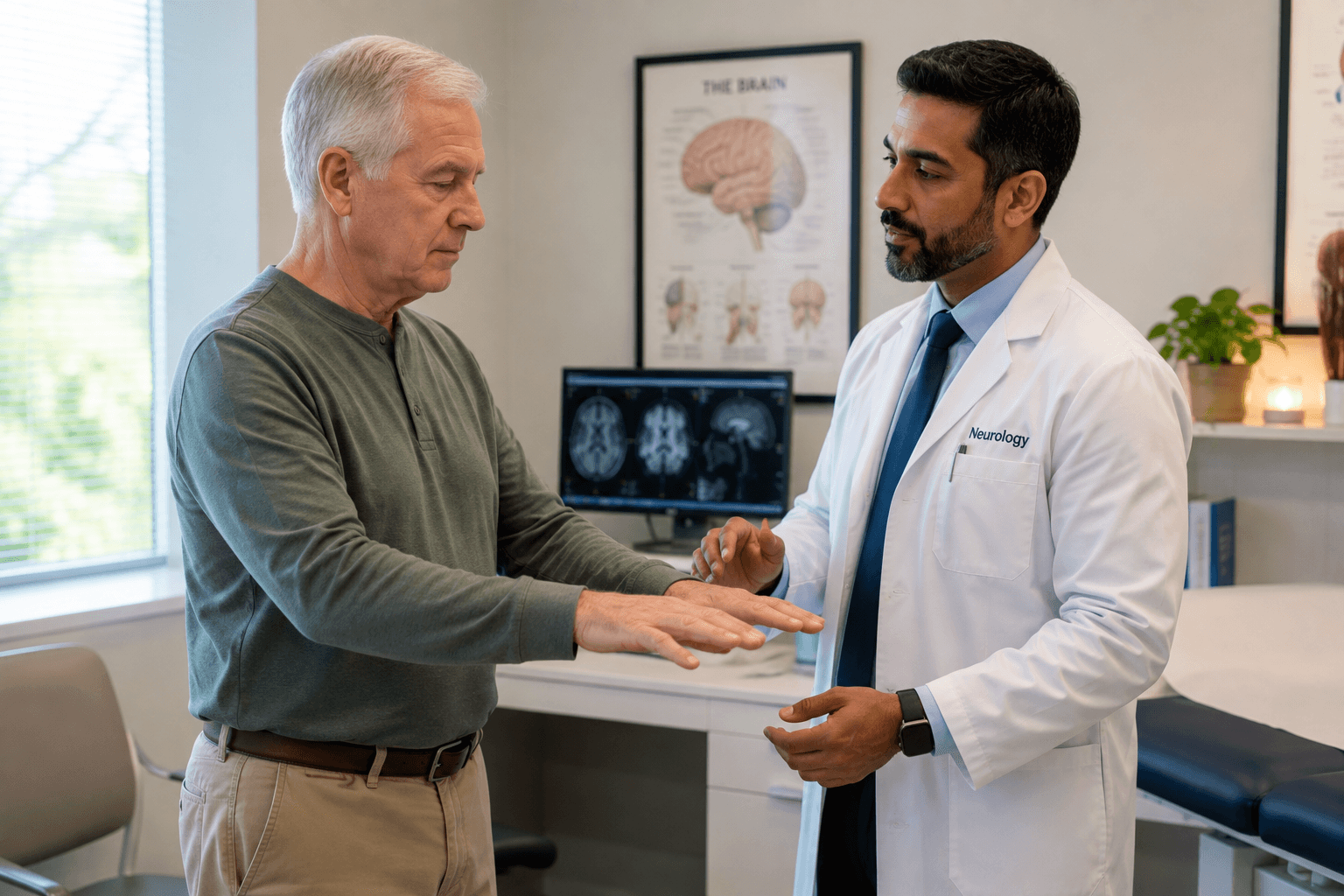
Most people picture Parkinson's disease as a tremor: a hand shaking at rest, a cup rattling in its saucer. Tremor is one of its hallmarks, but Parkinson's is more complex than that single image suggests. It is a progressive neurological condition that affects movement, mood, sleep, and more, and its earliest signs can appear years, sometimes more than a decade, before a diagnosis is made.
Understanding what Parkinson's actually looks like, what may raise a person's risk, and when it is worth calling a doctor can help patients and families navigate this condition with more confidence and less fear.
What Is Parkinson's Disease?
Parkinson's disease is caused by the gradual loss of neurons in a part of the brain called the substantia nigra. These neurons produce dopamine, a chemical messenger that coordinates smooth, controlled movement. As dopamine levels fall, the brain loses some of its ability to regulate how the body moves, and over time that loss touches many other functions as well.
It is the second most common neurodegenerative condition after Alzheimer's disease, and it can affect people of any background. It is most often diagnosed in people over 60, though a meaningful number of people receive a diagnosis before age 50, which clinicians call young-onset Parkinson's.
The Motor Symptoms: What Most People Recognize
The symptoms most people connect with Parkinson's involve movement, which is why doctors call them motor symptoms. The four classic ones are:
- Tremor at rest: A rhythmic shaking that typically occurs in a hand, finger, or jaw when the limb is relaxed. It often decreases when the person reaches for something or moves on purpose.
- Rigidity: Muscles feel stiff or resistant throughout their range of motion. This can cause aching in the arms, shoulders, or neck and is often noticed by a clinician during a physical exam.
- Bradykinesia: This is the medical term for slowness of movement. Everyday tasks like buttoning a shirt, getting up from a chair, or walking across a room take longer and require more effort than they used to.
- Postural instability: Difficulty maintaining balance, which typically appears later in the course of the disease. This raises the risk of falls and is an important focus of physical therapy.
Not everyone with Parkinson's experiences all four features, and they do not all appear at once. One person may have prominent tremor but little rigidity; another may have significant slowness but almost no visible tremor. This variability is one reason the condition is sometimes missed or mistaken for aging in its early stages.
The Non-Motor Symptoms: Broader Than Most People Expect
What surprises many newly diagnosed patients, and their families, is how much Parkinson's reaches beyond movement. Research has established that non-motor symptoms are a core part of the disease, not just side effects of medication or unrelated aging changes.
These can include:
- Changes in smell: A reduced or distorted sense of smell (called hyposmia or anosmia) is one of the earliest known features and may appear years before motor symptoms.
- Sleep disturbances: REM sleep behavior disorder, in which a person acts out their dreams, sometimes vividly and with sudden movements, has been identified as a significant early marker. Restless legs, insomnia, and excessive daytime sleepiness are also common.
- Constipation: The gut has its own nervous system, and disruption of dopamine signaling and other neural pathways can slow digestion considerably.
- Mood changes: Depression and anxiety are not just reactions to a difficult diagnosis. They are thought to be part of the neurological process itself, tied to changes in brain chemistry.
- Cognitive changes: Many people with Parkinson's eventually experience some degree of cognitive slowing or, in later stages, dementia. However, this is not universal, and its course varies widely from person to person.
- Low blood pressure when standing: Known as orthostatic hypotension, this can cause lightheadedness or fainting when rising from a seated or lying position.
- Soft speech or a masked face: The voice may become quieter or more monotone, and facial muscles may lose some expressiveness, which can be mistaken for emotional flatness.
Because these non-motor symptoms often appear first and span so many body systems, researchers increasingly understand Parkinson's as a whole-body condition rather than only a movement disorder.
What May Raise the Risk?
Parkinson's does not have a single known cause, and for most people it arises from a combination of factors that researchers are still working to untangle. That said, several influences have been studied carefully.
Age is the strongest known risk factor. The likelihood of developing Parkinson's rises with each decade of life, though the disease is by no means an inevitable part of aging.
Genetics play a role for some people. Researchers have identified a number of gene variants, including changes in genes called LRRK2, PINK1, and SNCA, that are linked to higher risk. In a small proportion of cases, Parkinson's follows a clearly inherited pattern. For the majority, genetic factors may increase susceptibility without being decisive on their own.
Environmental exposures have received considerable scientific attention. Observational research has found associations between long-term exposure to certain pesticides and herbicides and an elevated risk of Parkinson's. This does not mean that anyone exposed to these substances will develop the disease, but it has informed ongoing research into how environmental toxins may affect the dopamine-producing cells of the brain.
Sex appears to matter as well. Men are diagnosed with Parkinson's more often than women, though the reasons are not fully understood.
Head injury has been studied as a possible contributing factor, particularly repeated or severe traumatic brain injury. Research in this area is ongoing.
Having one or more of these risk factors does not mean a person will develop Parkinson's, and many people who develop it have no obvious risk factors at all.
When Should You Talk to a Doctor?
One of the most important things to know about Parkinson's disease is that earlier evaluation generally leads to better outcomes. Treatment cannot currently reverse the neurological changes that drive the disease, but it can manage symptoms effectively, and starting earlier tends to support quality of life, independence, and physical function for longer.
Consider reaching out to a primary care clinician if you or someone you love notices any of the following:
- A tremor in the hand, finger, chin, or foot, especially when the limb is at rest
- Handwriting that has become noticeably smaller over time
- A shuffling walk, reduced arm swing on one side, or difficulty starting to walk
- Significant stiffness in the arms, legs, or neck that is not explained by injury or arthritis
- A voice that has become softer, hoarser, or harder to project
- Vivid dream-enacting behavior during sleep, particularly if a bed partner has noticed it
- A noticeable loss of the sense of smell that has no other clear explanation
- A change in facial expression that feels involuntary or is remarked on by others
None of these symptoms automatically means Parkinson's; many have other explanations. But they are worth discussing with a clinician who can assess them in context. If Parkinson's seems possible, a referral to a neurologist, often one who specializes in movement disorders, is a reasonable next step.
A note on diagnosis: There is currently no single blood test or scan that definitively confirms Parkinson's disease. Diagnosis is based mainly on a detailed clinical examination: reviewing symptoms, their timeline, and how they respond to certain tests or medications. This is one reason seeing a neurologist with movement disorder expertise can help.
Living With Parkinson's: The Bigger Picture
A Parkinson's diagnosis changes life, but it does not end it. Many people live actively for years or decades after diagnosis, especially with a knowledgeable care team, appropriate treatment, and strong social support.
Management typically combines medication (most commonly levodopa, which helps replenish dopamine signaling in the brain), physical therapy, occupational therapy, speech therapy, and in some cases surgical options such as deep brain stimulation. Exercise in particular has emerged from research as one of the most consistently beneficial non-medication strategies, with benefits for motor symptoms as well as mood, cognition, and overall resilience.
Caregivers and family members are also a big part of the picture. Parkinson's affects households, not just individuals, and connecting with support groups, disease-specific organizations, and trained social workers can help families build resources before a crisis arises.
The Bottom Line
Parkinson's disease is complex, personal, and still incompletely understood, but it is not a condition to face without good information. Recognizing symptoms early, understanding what may influence risk, and building a relationship with a knowledgeable medical team are among the most useful steps a person can take. If something feels off, whether a tremor, a change in sleep, or a loss of smell that doesn't add up, it is worth a conversation with your doctor. Early questions rarely have easy answers, but they open the door to the care and support that can make a real difference.