That first step out of bed, the one that sends a sharp, stabbing pain shooting through your heel, is how most people discover they have plantar fasciitis. The plantar fascia is a thick band of connective tissue that runs along the bottom of your foot, connecting your heel bone to the base of your toes. When it becomes irritated or overloaded, even ordinary activities like walking to the kitchen or standing in line can feel brutal.
The good news is that plantar fasciitis is one of the more preventable and manageable musculoskeletal conditions. Research points to a consistent set of modifiable risk factors, meaning things you have some control over. Whether you've never had heel pain or you're recovering from a previous flare and want to stay out of trouble, this checklist covers the four key areas where small, consistent habits can make a meaningful difference.
Understanding Why It Happens
Before diving into the checklist, a quick explanation of the mechanics helps everything else make more sense. The plantar fascia acts a bit like a bowstring, supporting the arch and absorbing the shock of every step. Problems typically develop through one of two broad pathways: repetitive overload (too much stress, too fast) or chronic underloading that leaves the tissue weak and poorly adapted. Contrary to older thinking, the condition involves more tissue degeneration than pure inflammation, which is part of why it can be stubborn, and why rest alone rarely solves it.
With that in mind, the checklist below is organized into four categories: movement, ergonomics, strength, and rest.
Movement: How You Train and How Much
Physical activity is generally protective for foot health, but the way you ramp it up matters a great deal.
- Increase volume gradually. One of the most consistent findings in sports medicine research is that spikes in training load (running more miles, adding a new high-impact class, or spending much more time on your feet at a new job) are associated with overuse injuries including plantar fasciitis. A commonly cited principle is increasing weekly load by no more than roughly ten percent at a time, though the right rate varies by person and activity.
- Vary your surfaces. Hard, unforgiving surfaces like concrete and tile amplify ground reaction forces on every step. Mixing in softer surfaces (grass, rubberized tracks, packed trails) when possible gives your fascia periodic relief.
- Warm up before high-impact activity. Cold, stiff tissue is less resilient. A brief dynamic warm-up (ankle circles, calf raises, short walking lunges) helps prepare the foot and lower leg for load.
- Pay attention to pain signals. Mild muscle fatigue is normal during exercise; sharp or lingering heel pain is not. Pushing through pain often converts a minor irritation into a months-long problem.
- Include low-impact cross-training. Swimming, cycling, and water running let you maintain cardiovascular fitness and leg strength without pounding the plantar fascia. This is especially valuable during high-volume training periods.
Ergonomics: Footwear, Surfaces, and Your Daily Environment
You don't have to be a runner to develop plantar fasciitis. Teachers, nurses, retail workers, and anyone who stands for long stretches are well-represented among people who seek care for heel pain. Your environment and footwear choices are among the most actionable levers you have.
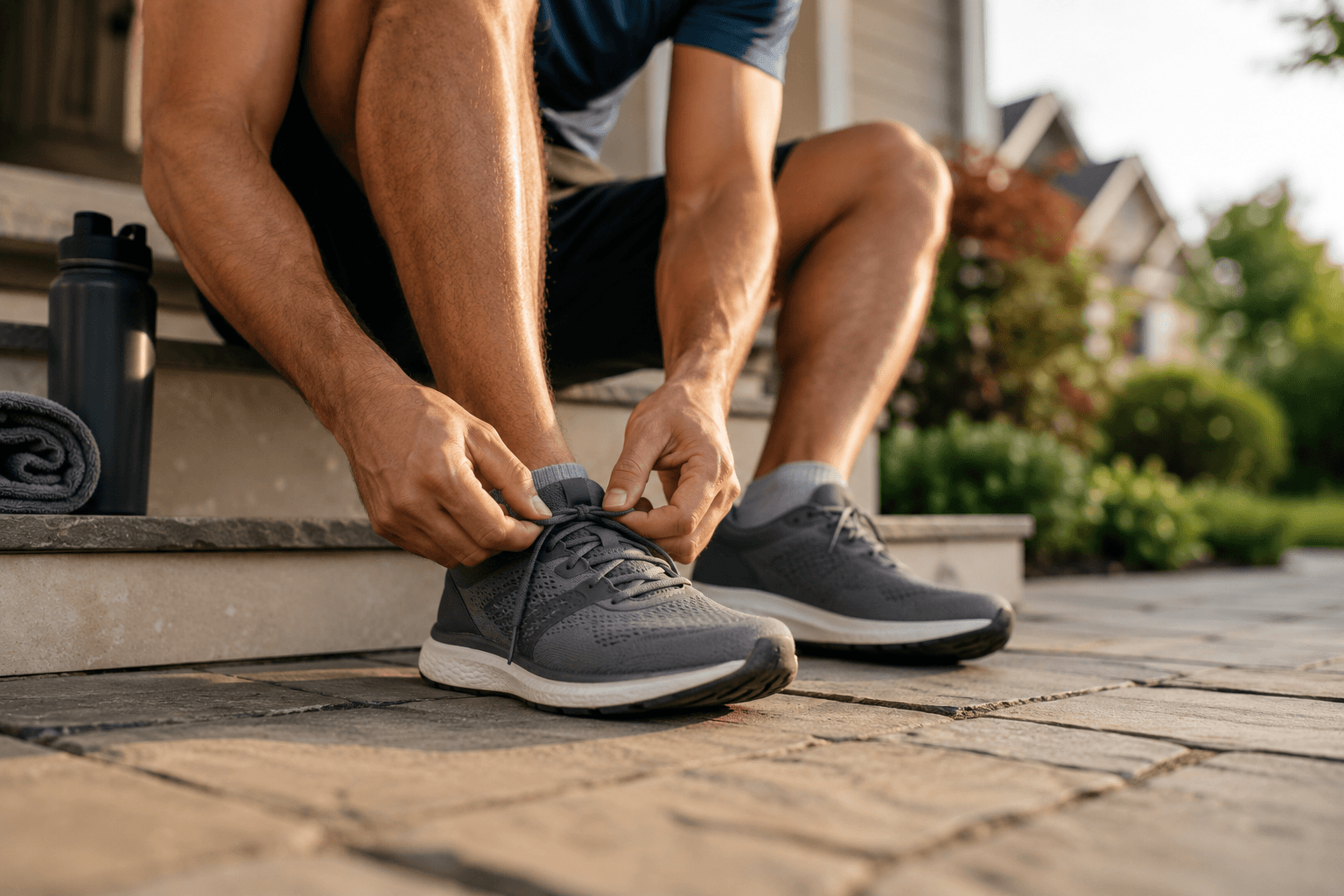
- Choose footwear with appropriate support for your foot type. This is not one-size-fits-all advice. People with lower arches (flat feet) and those with high arches have different support needs. A trained shoe-fitter or a podiatrist can help you identify what works for your foot. Look for shoes with adequate cushioning, a stable heel counter, and enough room in the toe box.
- Replace worn-out shoes. Cushioning and structural support degrade with use, often before the outer sole shows obvious wear. If you are on your feet all day or log significant mileage, tracking shoe age or mileage and replacing them on a regular schedule is worthwhile.
- Be cautious with flat, unsupportive shoes. Flip-flops, certain ballet flats, and thin-soled fashion shoes provide minimal arch support and force the plantar fascia to work harder with every step. They're fine occasionally; problems tend to arise when they become everyday footwear for people already at risk.
- Consider anti-fatigue mats for prolonged standing. Standing on hard floors for hours without a cushioned surface concentrates stress on the heel and arch. Anti-fatigue mats are widely used in occupational settings and are easy to add at a kitchen counter or workstation.
- Use orthotics if recommended. Off-the-shelf arch supports can help some people; custom orthotics prescribed by a podiatrist or physiatrist are appropriate for others. Neither is universally necessary, but if you have a foot structure that repeatedly causes problems, this is worth discussing with a clinician.
- Transition to minimalist or zero-drop footwear slowly, if at all. Lower-drop and minimal shoes have devoted advocates, and some evidence suggests they can improve foot strength over time. But abrupt transitions dramatically increase plantar fascia load and are a well-recognized cause of injury. If you want to explore this style, do so over months, not weeks, and ideally with guidance.
Strength: Building a Resilient Foundation
This is the category most people overlook, and arguably the most important for long-term prevention. The plantar fascia doesn't work in isolation. It is part of a kinetic chain that includes the intrinsic foot muscles, the calf complex (gastrocnemius and soleus), the Achilles tendon, and muscles further up the leg and hip. Weakness anywhere in this chain increases the load placed on the fascia itself.
- Train your calf complex with load. The soleus muscle, which sits beneath the larger gastrocnemius, has a particularly strong connection to plantar fascia health via the Achilles tendon. Loaded calf raises (especially slow, controlled single-leg raises with a slight knee bend to target the soleus) are one of the most evidence-supported exercises for both treating and potentially preventing plantar fasciitis. Start with body weight and progress gradually.
- Strengthen your intrinsic foot muscles. These small muscles support the arch from within. Exercises like towel scrunches, marble pickups, and short-foot exercises (gently doming the arch without curling the toes) can improve their function. They may seem trivial, but research on running biomechanics suggests they play a meaningful role in foot stability.
- Don't neglect your hips and glutes. Weakness in the hip abductors and external rotators can cause the knee and foot to collapse inward during walking and running, a pattern that loads the medial arch and fascia unevenly. Single-leg exercises like step-downs, lateral band walks, and split squats address this indirectly but effectively.
- Stretch consistently. Tight calves and a tight Achilles tendon are among the most reliably identified risk factors for plantar fasciitis. A simple standing calf stretch held for thirty seconds, performed several times daily, is low-effort and broadly recommended. Stretching the plantar fascia itself (pulling the toes back gently toward the shin before taking that first step in the morning) has good support in clinical literature as well.
- Progress strength work through a full range of motion. Strength through partial ranges of motion has limited transfer to real-world demands. Exercises that take the ankle and foot through their full movement range better replicate the stresses of walking and running.
Rest: Recovery as a Protective Strategy
In a culture that often rewards pushing harder and doing more, the role of rest in injury prevention is underappreciated. For connective tissue like the plantar fascia, recovery is not passive. It is when adaptation and tissue remodeling happen.
- Build rest days into your weekly schedule. Connective tissue has a slower metabolic rate than muscle and takes longer to adapt to training stress. At least one or two days of reduced lower-limb loading per week gives the fascia time to recover from cumulative stress.
- Prioritize sleep. Sleep is the body's primary window for tissue repair. Research across multiple musculoskeletal conditions consistently links poor or insufficient sleep with higher injury rates and slower recovery. Seven to nine hours per night is the broadly recommended range for most adults.
- Recognize early warning signs and back off promptly. Morning heel stiffness that resolves quickly, mild aching after activity, or a subtle change in how your foot feels during exercise can all be early signals. Responding early (a few days of reduced load and some gentle stretching) is almost always more effective than waiting until the pain is severe.
- Manage overall body load and stress. Psychological stress influences inflammation and pain perception through well-established biological pathways. Periods of high life stress may increase vulnerability to overuse injury. This isn't a reason for alarm; it's a reason to be a little more conservative with physical load during demanding stretches of life.
- Use supportive footwear even at home. Walking barefoot on hard floors first thing in the morning (when the fascia is at its stiffest after a night of inactivity) is a common aggravating factor. Keeping a pair of supportive slippers or shoes near the bed is a small habit with potentially meaningful impact.
A Note on When to See a Clinician
This checklist is designed for general risk reduction, not medical diagnosis or treatment. If you are experiencing persistent heel pain, especially pain that has lasted more than a few weeks, is getting worse, or is affecting your daily activities, please talk with a healthcare provider. A primary care physician, podiatrist, orthopedist, or physical therapist can confirm whether plantar fasciitis is the right diagnosis (other conditions can cause similar symptoms), assess your specific biomechanics, and build a targeted treatment plan.
The bottom line: Plantar fasciitis rarely appears out of nowhere. It develops from an accumulation of load, structural factors, and habits, which means it can often be interrupted before it becomes a problem. Start with the basics: gradual training, supportive footwear, consistent calf and foot strengthening, and adequate rest. These aren't glamorous interventions, but they're backed by the best evidence we have, and your feet will notice the difference.