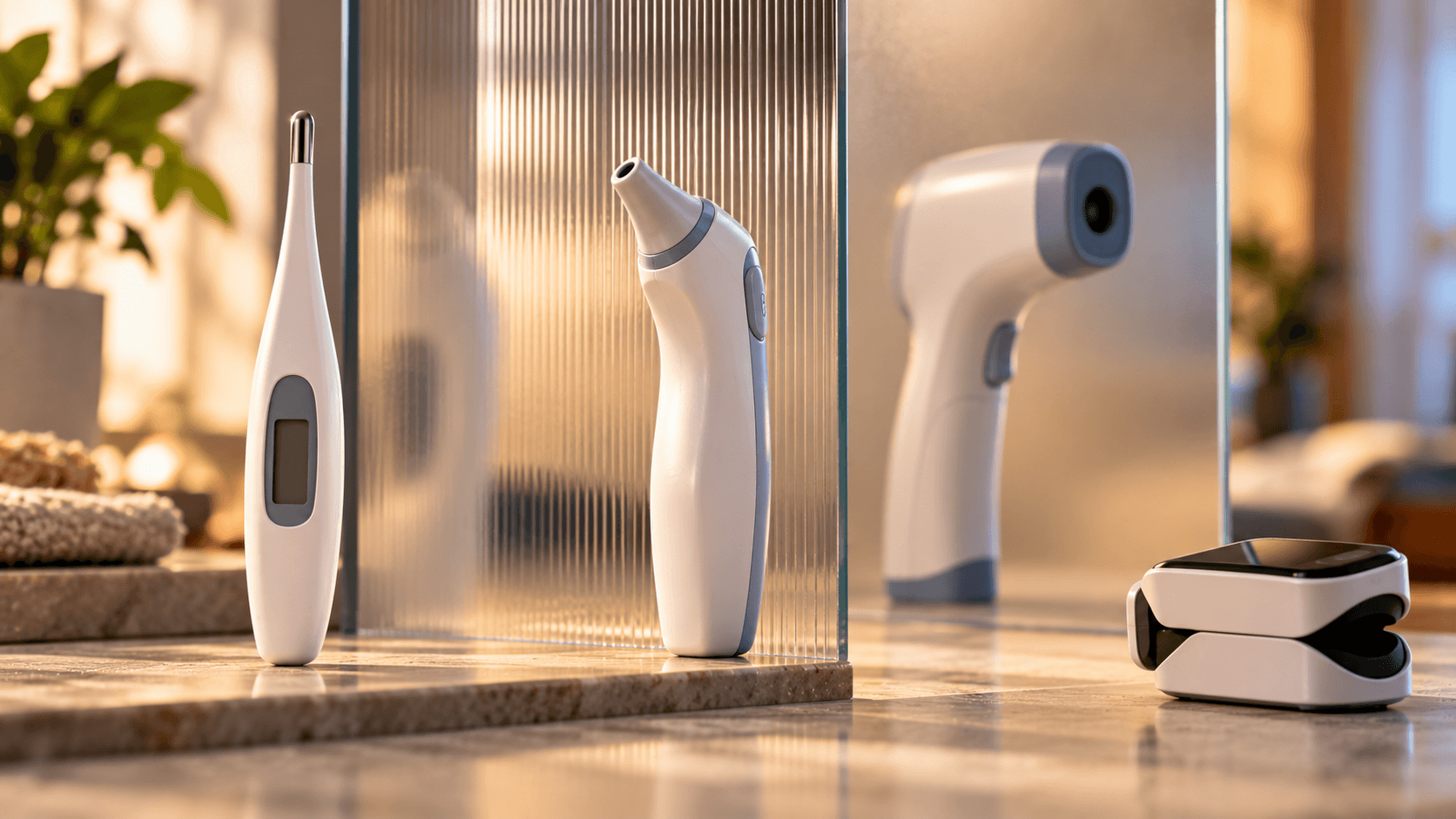
When someone in your household runs a fever, two devices tend to come off the shelf quickly: a thermometer and, increasingly since the COVID-19 pandemic, a pulse oximeter. Both are useful. Both are also easy to misread or misuse. Understanding what the numbers mean — and which product features actually improve accuracy — can help you make calmer, better-informed decisions about when to wait and watch versus when to call a clinician.
Why These Two Devices Are Often Used Together
Fever is the body's inflammatory response to infection or other stressors. It tells you something is happening, but not what. A pulse oximeter measures a different variable: the percentage of hemoglobin in your blood that is carrying oxygen, called oxygen saturation (SpO₂). Some illnesses — particularly respiratory infections — can lower oxygen saturation before a person feels short of breath. Pairing a temperature reading with an SpO₂ reading gives you a slightly broader picture of how the body is coping. That said, neither device replaces a clinician's evaluation, and readings from home devices should always be interpreted in context.
Thermometers: Types and What to Look For
Not all thermometers are created equal, and the differences go beyond price. The type of thermometer, where on the body you measure, and how carefully you follow the instructions all affect accuracy.
- Oral digital thermometers are widely recommended for adults and older children. They are inexpensive, highly accurate when used correctly (held under the tongue with the mouth closed), and easy to read. Look for a model with a flexible tip for comfort and a beep alert that signals the reading is complete.
- Rectal thermometers are considered the gold standard for infants under three months because rectal temperature most closely reflects core body temperature. This is an important clinical distinction: pediatric guidelines typically call for rectal readings in very young infants because even small errors in other methods can lead to missed fevers.
- Temporal artery (forehead) thermometers scan the temporal artery just beneath the skin of the forehead. They are fast, non-invasive, and popular for children. Research comparing them to rectal readings shows reasonable accuracy in most settings, though technique matters — the sensor must be swiped correctly and the forehead should be free of sweat or hair. They can read low if used improperly.
- Tympanic (ear) thermometers measure infrared heat from the eardrum. They are quick and generally well tolerated by older children and adults. Accuracy can drop if the ear canal is not straightened properly before inserting the probe, or if there is significant earwax buildup. They are generally not recommended for infants under six months.
- Non-contact infrared thermometers became common during the pandemic for screening purposes. They are convenient but tend to have more variability than other types, especially if the person has been outdoors in cold weather or is sweating heavily. For routine home monitoring, a contact thermometer is typically more reliable.
Features that genuinely matter:
- Accuracy rating: Look for devices cleared by the U.S. Food and Drug Administration (FDA). The label or packaging should indicate clearance for medical use.
- Memory recall: A model that stores recent readings lets you track a fever trend over hours, which is more informative than a single snapshot.
- Backlit display: Useful for nighttime readings without turning on a bright light.
- Fever alert: An audible or color-coded signal when the reading crosses a threshold can be reassuring — but always look at the actual number, not just the alert.
- Ease of cleaning: Waterproof or wipeable designs reduce the risk of spreading germs between uses.
A practical note: A single high temperature reading in someone who feels well and has no other symptoms may be a measurement error. Repeat the reading after five minutes, following the instructions exactly. Fever trends over time are more meaningful than one number.
What "Fever" Actually Means
The traditional threshold of 98.6°F (37°C) as "normal" is an average, not a fixed rule. Normal body temperature varies by person, time of day, age, and where on the body the measurement is taken. Most clinical guidelines define fever in adults as an oral temperature at or above 100.4°F (38°C). The threshold for concern in infants is lower, and any fever in a newborn warrants prompt medical attention. Your clinician can give you personalized guidance on what temperature to watch for in your household.
Pulse Oximeters: How They Work and What to Look For
A pulse oximeter clips onto a fingertip (or sometimes an earlobe or toe) and uses two wavelengths of light to estimate how much of the hemoglobin in your blood is saturated with oxygen. It also displays your pulse rate. The technology is the same used in hospitals, though consumer-grade devices vary in how tightly they are manufactured and validated.
For most healthy adults and older children, SpO₂ readings at rest typically fall within a range that clinicians consider normal. A sustained drop below that range — especially combined with symptoms like shortness of breath, confusion, or a bluish tint to the lips — is a signal to seek care promptly. The key word is sustained: brief dips during movement or a poor sensor fit are common and usually not meaningful.
Features that genuinely matter:
- FDA clearance: As with thermometers, look for devices that have been cleared by the FDA for medical use. This indicates the manufacturer has provided evidence of accuracy to a regulatory body. Many low-cost devices sold as "wellness" gadgets have not gone through this process.
- Perfusion index (PI) indicator: Some models display a perfusion index — a measure of how strong the pulse signal is at the sensor site. A low PI suggests the reading may be less reliable (common with cold fingers or poor circulation). This feature helps you know when to reposition or warm the finger before trusting the number.
- Waveform or bar graph display: A plethysmograph waveform or signal-strength bar shows whether the device is getting a clean pulse signal. A flat or erratic waveform is a red flag that the reading may not be accurate.
- Alarm function: Useful if you are monitoring someone while they sleep, though consumer devices should not replace prescribed medical monitoring equipment.
- Fit and probe size: Most fingertip oximeters are designed for average adult fingers. A poor fit — too loose or too tight — reduces accuracy. Pediatric or smaller probes are available for children; placing an adult oximeter on a child's finger may give unreliable readings.
An Important Limitation: Skin Tone and Oximeter Accuracy
This is a point that deserves honest attention. Research — including studies reviewed by the FDA — has found that standard pulse oximeters can overestimate oxygen saturation in people with darker skin tones, potentially masking a true drop in blood oxygen. This happens because the light wavelengths used by the devices can be affected by melanin in the skin. The FDA has issued communications to clinicians about this limitation, and work is ongoing to develop more equitable devices. If you or a family member has darker skin and you are relying on a pulse oximeter to monitor a respiratory illness, discuss this limitation explicitly with your care team.
Tips for Getting Accurate Readings at Home
- For thermometers: Wait at least 15 to 30 minutes after eating, drinking, or exercising before taking an oral temperature. For ear thermometers, gently pull the ear back and up (for adults) to straighten the canal. Always read the device's instructions — the right technique varies by model.
- For pulse oximeters: Warm cold hands before measuring. Remove nail polish or artificial nails from the finger being used, as these can interfere with the light signal. Sit still during the reading and hold the finger at heart level. Wait for the reading to stabilize — usually a few seconds — before recording it.
- Log your readings: Write down the time, measurement method, and result. Sharing this log with a clinician gives them far more useful information than a single number recalled from memory.
When to Contact a Clinician
Home monitoring tools are meant to inform, not replace, professional judgment. Contact a clinician or seek urgent care if:
- A fever is very high, prolonged, or accompanied by severe symptoms such as difficulty breathing, chest pain, confusion, a stiff neck, or a rash.
- Any fever occurs in an infant under three months of age.
- A pulse oximeter reading is consistently low or dropping, especially alongside symptoms.
- You are uncertain how to interpret what you are seeing, or something simply feels wrong.
Trust your instincts alongside the numbers. Monitoring devices provide data points; they do not capture the full picture of how a person looks, feels, and is functioning. When in doubt, reach out to a health professional who can help you put the readings in context.
The Bottom Line
A reliable thermometer and a properly used pulse oximeter can be genuinely valuable additions to a home health kit — particularly for households with infants, older adults, or people with chronic health conditions. The most important features to prioritize are regulatory clearance (look for FDA-cleared labeling), accurate technique, and an understanding of each device's limitations. Knowing what the numbers mean, and what they don't, is just as important as having the devices in the first place.