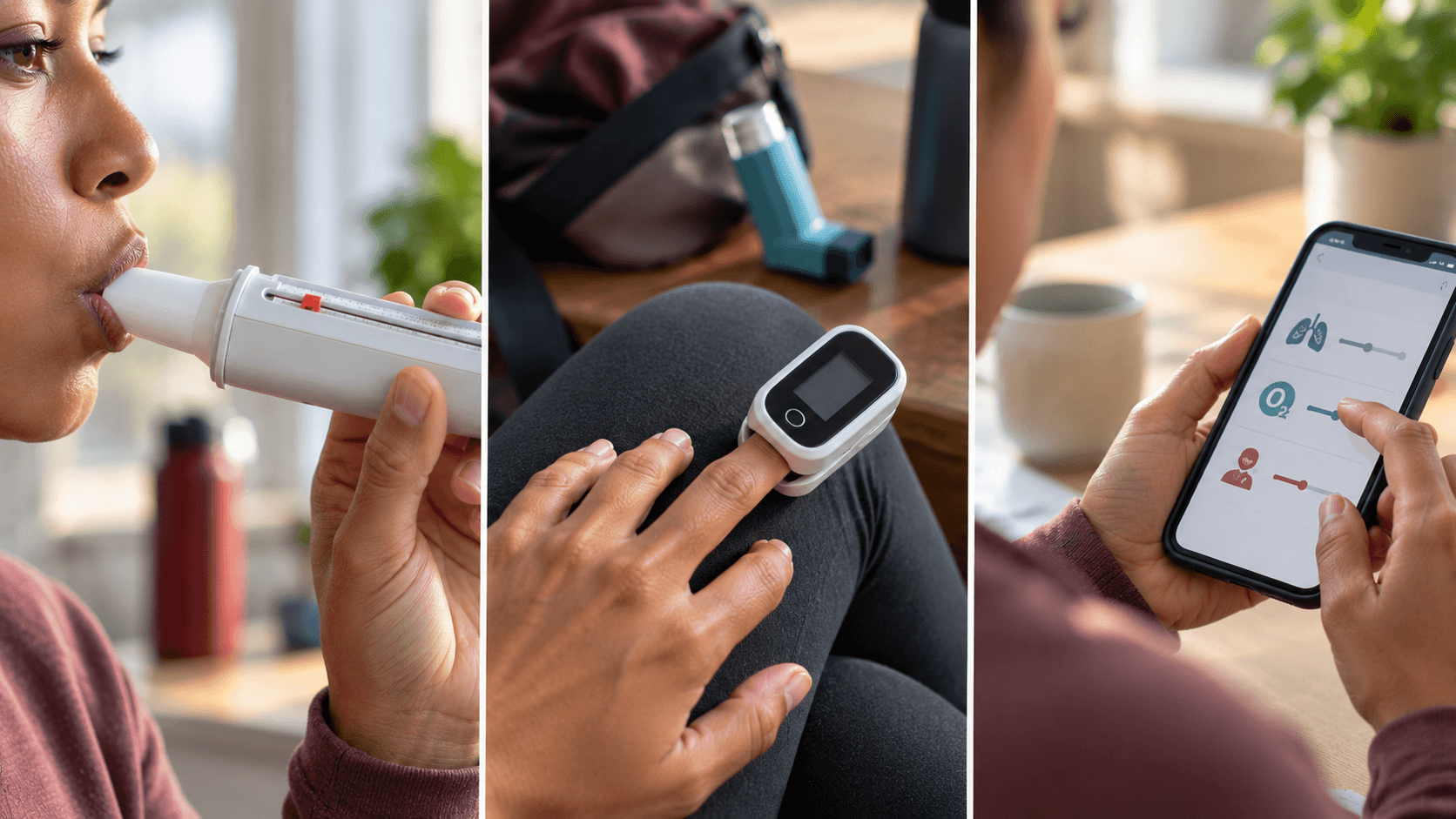
Asthma symptoms can change from day to day. Some people notice wheezing, coughing, chest tightness, or shortness of breath. Others mainly notice reduced activity, nighttime symptoms, frequent rescue inhaler use, or feeling more winded than usual.
Tracking can help you and your clinician see whether asthma is controlled, whether triggers are changing, whether medicines are working, and when an asthma action plan should be adjusted. The goal is not constant checking. The goal is a simple record that helps guide safer decisions.
This guide explains how to track breathing symptoms, oxygen readings, peak flow, inhaler use, triggers, and urgent warning signs. Bring your log to visits with your primary care clinician, pulmonologist, allergist, pharmacist, respiratory therapist, or asthma educator.
Why Tracking Matters With Asthma
Asthma affects the airways in the lungs and can cause symptoms such as coughing, wheezing, chest tightness, and trouble breathing. The CDC notes that asthma attacks can happen when something bothers the lungs, and that asthma management includes knowing triggers, using medicines correctly, and following an asthma action plan.
NHLBI explains that asthma care involves long-term monitoring and a customized action plan. A written plan can help you know how to monitor asthma, treat changing symptoms, and respond to attacks.
A useful asthma tracking log should answer four questions: What symptoms happened? What was breathing like? What treatment was used? What might have triggered it?
Track Symptoms in Plain Language
Asthma symptoms are more useful when they are specific. Instead of writing "bad breathing," write what actually happened and how it affected your day.
- Coughing, wheezing, chest tightness, or shortness of breath
- Waking at night because of asthma symptoms
- Trouble talking in full sentences
- Reduced ability to exercise, work, walk, climb stairs, or play
- Symptoms that return after using a reliever inhaler
NHLBI lists coughing, wheezing, chest tightness, and shortness of breath as common asthma symptoms, and advises working with a healthcare provider on an asthma action plan when symptoms suggest asthma may be worsening.
Track How Often Symptoms Happen
Frequency matters. Occasional symptoms may suggest a different level of control than symptoms happening every day, every night, or with normal activity.
- "How many days this week did I have symptoms?"
- "How many nights did symptoms wake me?"
- "How often did I use my quick-relief medicine?"
- "Did symptoms limit work, school, exercise, or sleep?"
The American Lung Association recommends assessing asthma control by looking at symptoms, activity limitations, nighttime awakenings, and quick-relief inhaler use.
Track Reliever Inhaler Use
Reliever use can show whether symptoms are becoming more frequent. Record each time you use a quick-relief inhaler or other reliever medicine.
- Date and time used
- Reason you used it
- Number of puffs or doses
- Whether symptoms improved
- How long relief lasted
Do not increase asthma medicine beyond your action plan unless your clinician has told you how. If you need reliever medicine more often than usual, or it is not helping, contact your clinician or follow the urgent steps in your asthma action plan.
Track Controller Medicine Adherence
Controller medicines are taken to reduce airway inflammation and prevent symptoms. Missing doses can make asthma harder to control, even if you feel fine at first.
- Record missed doses and why they happened.
- Track side effects such as hoarseness, throat irritation, tremor, fast heartbeat, or mouth irritation.
- Write down refill problems, cost barriers, or confusion about timing.
- Bring inhalers to visits so technique can be checked.
Ask your clinician or pharmacist to watch your inhaler technique. Poor technique can make a medicine seem ineffective when the issue is delivery.
Track Peak Flow if Your Clinician Recommends It
A peak flow meter measures how fast you can blow air out. Some people use peak flow readings as part of an asthma action plan, especially when symptoms are hard to recognize or when asthma has been difficult to control.
- Ask what your personal best peak flow is.
- Record the number, date, time, and symptoms.
- Use the same meter and technique each time.
- Follow your action plan's green, yellow, and red zone instructions.
NHLBI says a provider may show you how to track asthma with a peak flow meter as part of an asthma action plan. MedlinePlus also describes a peak flow meter as a small device that helps check how well asthma is controlled.
Know What Peak Flow Zones Mean
Peak flow zones are usually based on your personal best, not someone else's number. Your clinician should help you calculate the zones and write down what to do in each one.
- Green zone usually means breathing is stable and the usual plan continues.
- Yellow zone usually means asthma is worsening and the plan should be adjusted.
- Red zone usually means urgent action may be needed.
Do not guess zone instructions. Ask your clinician to write them clearly, including which medicine to take, when to recheck, when to call, and when to seek emergency care.
Track Oxygen Readings Carefully
A pulse oximeter estimates oxygen saturation, often shown as SpO2. Some people with asthma may be told to use one during illness or severe symptoms, but not everyone with asthma needs daily oxygen tracking.
- Ask whether oxygen monitoring is useful for your asthma plan.
- Ask what reading is normal for you.
- Record oxygen saturation, pulse, date, time, and symptoms.
- Do not ignore breathing distress just because a reading looks normal.
A Cochrane review on pulse oximeters for asthma found that if home oxygen monitoring is studied or used for asthma, it should be part of a personalized asthma action plan rather than used alone.
Measure Oxygen the Right Way
Pulse oximeter readings can be affected by cold fingers, movement, nail polish, poor circulation, device quality, skin pigmentation, altitude, and incorrect placement. A single reading may not tell the whole story.
- Rest for a moment before checking.
- Warm your hands if they are cold.
- Keep the finger still and wait for the reading to stabilize.
- Record the number and symptoms together.
- Call for help if breathing is worsening, even if the number is not dramatically low.
Breathing effort, ability to speak, chest tightness, wheezing, confusion, lip color, and response to reliever medicine can matter as much as the oxygen number.
Track Breathing Effort, Not Just Numbers
Asthma can worsen before oxygen readings fall. Watch how breathing looks and feels.
- Can you speak full sentences?
- Are ribs, neck, or chest muscles pulling in with breaths?
- Are you breathing faster than usual?
- Are you sitting upright or leaning forward to breathe?
- Are symptoms improving after reliever medicine?
NHLBI advises following your asthma action plan during asthma attacks and seeking medical attention if symptoms do not go away soon after taking reliever medicine.
Track Triggers Without Blaming Yourself
Triggers are not always obvious. A log can help you notice patterns over time.
- Colds, flu, COVID-19, RSV, or other respiratory infections
- Exercise, cold air, smoke, wildfire smoke, air pollution, or strong odors
- Dust mites, mold, pets, pollen, pests, or workplace exposures
- Stress, poor sleep, reflux, weather changes, or missed medication
- New medicines, cleaning products, sprays, or vaping exposure
CDC guidance emphasizes avoiding asthma triggers when possible and having an asthma action plan that explains what to do when symptoms worsen.
Track Respiratory Infections Early
Colds and respiratory viruses are common asthma flare triggers. Track symptoms early so treatment can be adjusted before breathing worsens.
- Fever, sore throat, runny nose, cough, body aches, or fatigue
- COVID-19, flu, or RSV test results if performed
- Changes in wheezing, chest tightness, peak flow, or oxygen readings
- Increased reliever use or nighttime symptoms
Ask your clinician whether your asthma action plan changes when you get sick, and whether you should test for respiratory viruses or seek early treatment based on your risk.
Track Activity Limits
Asthma control is not only about avoiding attacks. If you stop exercising, playing, walking, working, or sleeping normally because of breathing, that is important information.
- Record activities you skipped because of symptoms.
- Track symptoms during exercise or after exercise.
- Note whether warm-up, medication timing, or indoor air helped.
- Ask when exercise symptoms suggest poor control.
The American Lung Association's asthma action plan materials include activity level as an important part of assessing symptoms, including whether breathing problems interfere with working, exercising, or playing.
Track Nighttime Symptoms
Nighttime symptoms can be a sign that asthma is not well controlled. They can also overlap with reflux, allergies, postnasal drip, sleep apnea, medication timing, or indoor triggers.
- How often did coughing, wheezing, or chest tightness wake you?
- Did you need reliever medicine at night?
- Did symptoms happen after lying down?
- Were pets, dust, bedding, mold, or room temperature involved?
Bring nighttime symptom patterns to your clinician. They may affect medication timing, trigger control, allergy treatment, reflux evaluation, or the need to update your action plan.
Use an Asthma Action Plan
An asthma action plan is a written plan that explains daily management, what to do when symptoms worsen, and when to seek urgent care.
- Ask for your green, yellow, and red zone instructions.
- Write down daily controller medicines and reliever medicines.
- Include peak flow zones if you use a peak flow meter.
- Include emergency contact numbers and urgent warning signs.
CDC says everyone with asthma needs their own asthma action plan. GINA also recommends that all patients have a written asthma action plan appropriate for their age, treatment regimen, reliever inhaler, asthma control level, and health literacy.
What to Bring to Asthma Visits
Your clinician can make better decisions when they can see patterns.
- Symptom log, including daytime and nighttime symptoms
- Reliever use and controller medicine adherence
- Peak flow readings if used
- Oxygen readings if your clinician told you to monitor them
- Trigger notes, infection history, and activity limits
- All inhalers, spacers, nebulizer medicines, and over-the-counter products
- Questions about side effects, cost, refills, and technique
Ask your clinician to check inhaler technique, spacer use, medication timing, and whether your current action plan still fits your symptoms.
Home Tools That May Help
Home tools can support asthma care when they are matched to your plan. Helpful options may include a symptom diary, peak flow meter, spacer, medication organizer, inhaler counter, pulse oximeter if recommended, thermometer, air quality app, allergen-control checklist, and asthma action plan.
A pulse oximeter should not replace an action plan, clinical care, or emergency evaluation. A peak flow meter is most useful when your clinician has helped you identify your personal best and action zones.
Use tools to recognize patterns and communicate with your care team, not to create constant checking or anxiety.
Common Mistake: Tracking Oxygen but Not Symptoms
Oxygen can stay normal even when asthma symptoms are worsening. Breathing effort, wheezing, chest tightness, reliever response, and ability to speak or move matter.
Record oxygen readings with symptoms, not instead of symptoms.
If breathing feels dangerous, seek help even if the device reading is not alarming.
Common Mistake: Using a Peak Flow Meter Without a Personal Best
Peak flow numbers are most useful when they are compared with your own best reading. A random number without zones can be confusing.
Ask your clinician to help define your personal best and action-plan zones.
Do not use someone else's zones or internet-based thresholds for your asthma plan.
Common Mistake: Ignoring Nighttime Symptoms
Nighttime coughing, wheezing, or reliever use can suggest asthma is not controlled. It should not be dismissed as normal.
Track how often it happens and what might be triggering it.
Ask whether medication, allergies, reflux, sleep apnea, or bedroom exposures need review.
Common Mistake: Changing Medicines Without the Action Plan
Asthma plans often include specific steps for worsening symptoms, but guessing doses can be unsafe.
Do not stop controller medicine because you feel better unless your clinician instructs you to do so.
Do not repeatedly increase reliever use without contacting your care team or following your action plan.
Common Mistake: Waiting Too Long When Medicine Is Not Helping
If reliever medicine is not helping, symptoms return quickly, or breathing is getting worse, do not wait.
Follow the red-zone instructions in your asthma action plan and seek urgent care when needed.
Delayed care can make an asthma attack more dangerous.
When to Call Your Clinician
Call your clinician if symptoms are becoming more frequent, nighttime symptoms occur, activity is limited, reliever use increases, peak flow drops into your yellow zone, oxygen readings are lower than your usual baseline, or you have symptoms after a respiratory infection.
You should also call if side effects occur, inhalers run out early, you are unsure how to use medicines, triggers are hard to control, or you need to update your asthma action plan.
Your clinician may recommend inhaler technique review, medication adjustment, allergy evaluation, spirometry, peak flow tracking, trigger reduction, respiratory infection testing, or referral to an asthma specialist.
When to Seek Urgent or Emergency Care
Seek urgent or emergency care if breathing is hard and worsening, reliever medicine is not helping, you cannot speak in full sentences, lips or face look blue or gray, you are confused or very drowsy, chest tightness is severe, peak flow is in the red zone, or oxygen is low for you or falling quickly.
Call emergency services if symptoms feel life-threatening, if a child is struggling to breathe, if ribs or neck muscles are pulling in with breaths, or if there is severe chest pain, fainting, or confusion.
Do not drive yourself if you may be having a severe asthma attack.
The Bottom Line
Asthma tracking works best when it combines symptoms, breathing effort, reliever use, controller adherence, triggers, nighttime symptoms, activity limits, peak flow when recommended, and oxygen readings when your clinician says they are useful.
Helpful items to record include coughing, wheezing, chest tightness, shortness of breath, nighttime awakenings, rescue inhaler use, peak flow zones, oxygen readings, respiratory infections, activity limits, and possible triggers.
The most common mistakes are tracking oxygen but not symptoms, using a peak flow meter without a personal best, ignoring nighttime symptoms, changing medicines without the action plan, and waiting too long when medicine is not helping.
Bring your log to your next visit and ask your clinician to turn it into a written asthma action plan with clear green, yellow, and red zone steps.