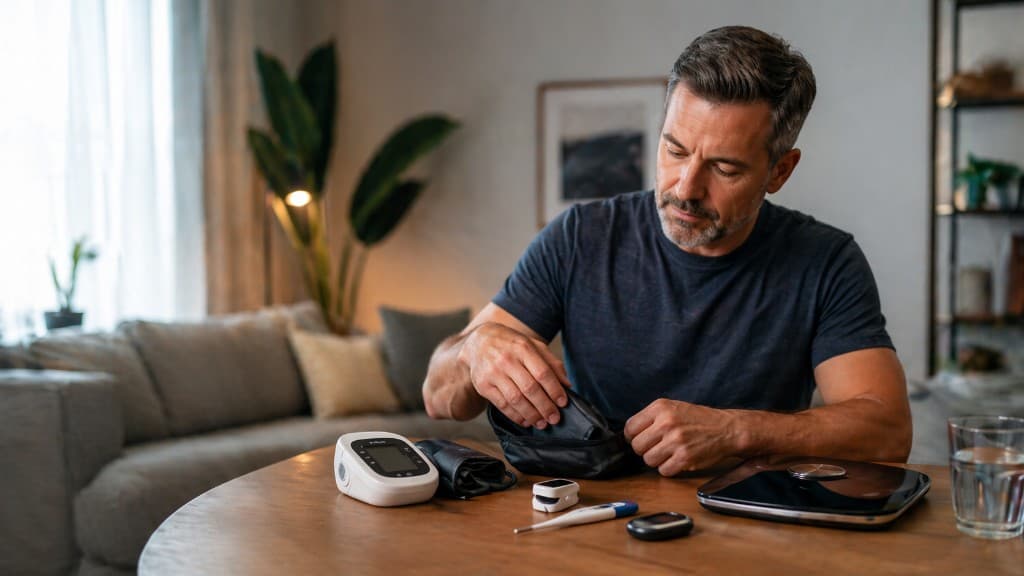
The home health monitoring market is booming — most of it isn’t worth your money
Smart scales, blood pressure cuffs, pulse oximeters, continuous glucose monitors, sleep trackers, EKG watches — the home health device market is projected to exceed $60 billion by 2027. Walk into any pharmacy and you’ll find dozens of options. Search Amazon and you’ll find hundreds.
The question isn’t whether home monitoring is valuable — it absolutely is. The question is which devices actually provide actionable, accurate data versus which ones are expensive toys that create anxiety without improving outcomes.
We’ve tested over 200 devices across 15 categories at HealthRankings. Here’s what’s actually worth buying.
The three highest-value home health devices for most adults are: a validated blood pressure monitor, a body composition scale, and a pulse oximeter. Everything else is condition-specific or nice-to-have.
Blood pressure monitors (★ essential)
If you buy one health device, make it a blood pressure monitor. Hypertension is the leading modifiable risk factor for heart disease and stroke, and home monitoring is more accurate than office readings for most people.
What to look for:
- Upper-arm cuff (not wrist) — significantly more accurate
- Clinically validated — check the STRIDE BP or BHS/ESH validation list
- Bluetooth connectivity — automatic data logging removes the friction of manual tracking
- Appropriate cuff size — a cuff that’s too small gives falsely high readings
Budget: $40–$80 for an excellent monitor. Our top pick is the Omron Platinum BP5450 ($60) — validated, Bluetooth-connected, and consistently accurate in our testing.
Body composition scales (★ highly recommended)
A good smart scale does more than weigh you. Bioelectrical impedance analysis (BIA) estimates body fat percentage, muscle mass, visceral fat, and water composition — all more informative than weight alone.
What to look for:
- Multi-frequency BIA — more accurate than single-frequency (most cheap scales)
- Segmental measurement — measures each limb separately, improving accuracy
- App integration — trends over time are far more useful than any single reading
Accuracy caveat: no consumer BIA scale matches a DEXA scan. But they’re excellent for tracking trends — and that’s what matters for health management.
Pulse oximeters (★ recommended for specific conditions)
Pulse oximeters measure blood oxygen saturation (SpO2). Normal is 95–100%. Below 92% is a medical concern. They’re essential for people with COPD, sleep apnea, heart failure, or recovering from respiratory illness.
For healthy adults, a pulse oximeter is useful but not essential. If you have any respiratory or cardiac condition, it’s a must-have — and they’re only $20–$40.
Continuous glucose monitors (condition-specific)
CGMs (Dexcom G7, FreeStyle Libre 3) are transformative for people with diabetes — providing continuous glucose data that finger sticks can’t match. For non-diabetics, the value is more limited. A 2-week trial can be educational for understanding your metabolic responses, but ongoing use without diabetes is expensive and usually unnecessary.
Smartwatches and fitness trackers (supplementary)
The Apple Watch, Garmin, and Fitbit ecosystem offer heart rate monitoring, irregular rhythm detection (AFib), sleep tracking, and activity metrics. They’re useful as general wellness tools but shouldn’t replace dedicated medical devices for specific conditions. An Apple Watch can detect AFib but can’t replace a blood pressure cuff.
What to skip
- Wrist blood pressure monitors — significantly less accurate than upper-arm models
- Single-frequency body fat scales under $20 — inaccurate enough to be misleading
- At-home blood test kits with no physician review — results without context can cause unnecessary anxiety
- UV light sanitizers, posture correctors, and "detox" devices — no meaningful clinical evidence
The bottom line
Start with a validated blood pressure monitor ($50–80) and a decent smart scale ($40–70). If you have a specific condition, add the relevant device (pulse oximeter for respiratory issues, CGM for diabetes). Track trends over weeks and months, share data with your doctor, and don’t let any single reading cause panic. The goal is information, not anxiety.