It's a vicious cycle — and breaking it starts with understanding it
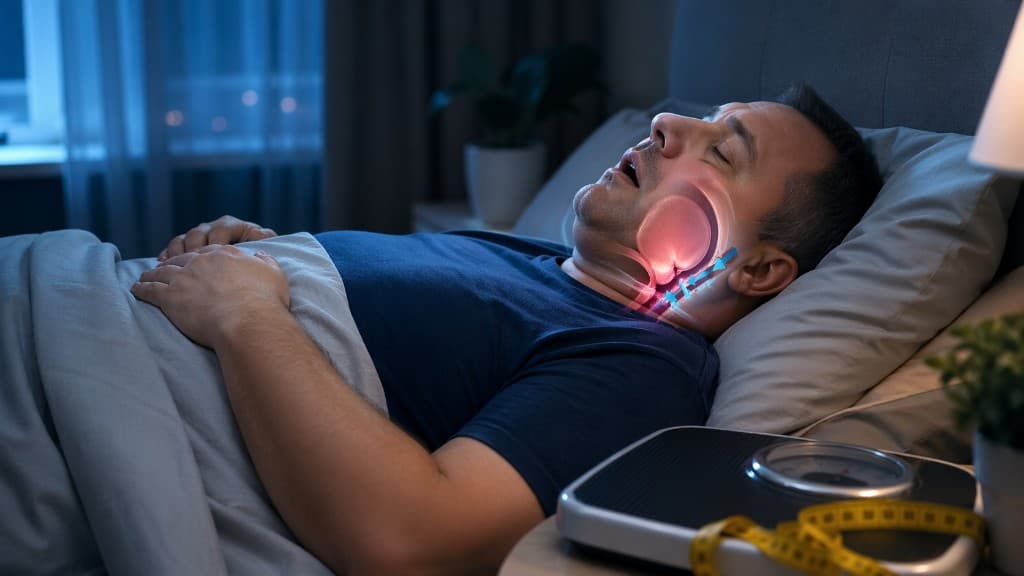
Sleep apnea and weight gain feed each other. Excess weight — particularly around the neck and abdomen — narrows the airway and increases the severity of obstructive sleep apnea (OSA). And sleep apnea, in turn, disrupts hormones that regulate hunger and metabolism, making it harder to lose weight.
An estimated 22 million Americans have sleep apnea, and up to 80% of moderate-to-severe cases remain undiagnosed. Among people with a BMI over 35, the prevalence of OSA exceeds 70%.
Sleep apnea and weight gain create a bidirectional cycle: excess weight worsens apnea, and apnea makes weight loss harder. Breaking the cycle at either point — even modestly — produces improvements on both sides.
How weight worsens sleep apnea
Fat deposits around the pharynx (upper throat) physically narrow the airway. During sleep, when muscle tone naturally relaxes, this narrowing becomes critical — the airway collapses partially or completely, causing the characteristic pauses in breathing.
Abdominal fat is equally problematic. It pushes the diaphragm upward, reducing lung volume and pulling on the upper airway structures, making collapse more likely. This is why waist circumference correlates with sleep apnea severity more strongly than BMI alone.
A 10% weight gain increases the odds of developing moderate-to-severe OSA by six-fold, according to the Wisconsin Sleep Cohort Study — one of the longest-running sleep studies in the world.
How sleep apnea drives weight gain
This is the side most people don't hear about. Sleep apnea doesn't just result from weight — it actively promotes it through several mechanisms:
- Leptin resistance: Leptin is the hormone that tells your brain you're full. OSA causes chronically elevated leptin levels, which paradoxically makes your brain less sensitive to the signal. You feel hungrier than you should.
- Elevated ghrelin: Ghrelin is the "hunger hormone." Sleep deprivation from apnea raises ghrelin levels, increasing appetite — particularly for high-carb, high-calorie foods.
- Cortisol spikes: Each apnea episode triggers a micro-arousal and a stress response. Repeated dozens of times per night, this chronically elevates cortisol, which promotes visceral fat storage.
- Daytime fatigue: Poor sleep means less energy for exercise. People with untreated OSA are significantly less physically active than matched controls.
- Insulin resistance: OSA independently increases insulin resistance — even after controlling for weight. This shifts metabolism toward fat storage rather than fat burning.
A 2022 meta-analysis in Chest found that untreated OSA increased the risk of weight gain over 5 years by 35%, independent of baseline BMI. The hormonal disruption — not just poor willpower — is a major driver.
Breaking the cycle
The good news: interventions on either side of the cycle produce improvements on both. You don't need to solve everything at once.
Weight loss: the most effective treatment
Losing 10–15% of body weight can reduce the Apnea-Hypopnea Index (AHI — the number of breathing disruptions per hour) by 50% or more. In some cases, moderate weight loss eliminates sleep apnea entirely.
The Sleep AHEAD study found that participants who lost an average of 10 kg through lifestyle intervention had a 3-fold higher rate of OSA remission compared to controls. Even losing 5% of body weight produces measurable improvements in AHI and oxygen saturation.
CPAP: treating apnea to enable weight loss
CPAP (Continuous Positive Airway Pressure) is the gold standard treatment for moderate-to-severe OSA. By keeping the airway open during sleep, CPAP restores normal sleep architecture, normalizes oxygen levels, and reduces the hormonal disruptions that drive weight gain.
Studies show that consistent CPAP use (4+ hours per night) reduces daytime sleepiness, improves insulin sensitivity, and lowers cortisol — creating a metabolic environment that makes weight loss more achievable. CPAP alone doesn't cause weight loss, but it removes a significant biological barrier to it.
Practical strategies
- Get tested: If you snore loudly, wake unrefreshed, or have a neck circumference above 17" (men) or 16" (women), ask your doctor about a sleep study. Home sleep tests are now widely available and covered by most insurance.
- Use CPAP consistently: Adherence is the biggest challenge. Modern devices are quieter and more comfortable. Give it at least 30 days and work with your sleep clinic on mask fit.
- Sleep on your side: Apnea is typically worse when sleeping on your back. A positional therapy device or even a tennis ball taped to the back of your shirt can help.
- Limit alcohol before bed: Alcohol relaxes airway muscles and worsens apnea by 25–50%.
- Prioritize gradual weight loss: Crash diets backfire. A sustainable 500-calorie daily deficit with increased protein and walking is more effective long-term.
The bottom line
Sleep apnea and weight aren't just correlated — they actively cause each other to worsen. The cycle feels impossible to break from the inside, which is why most people need to attack it from both directions simultaneously: treat the apnea (usually CPAP) to restore normal sleep and hormones, and pursue gradual weight loss to reduce airway obstruction.
If you're overweight and struggling with fatigue, poor sleep, or unexplained weight gain resistance — get screened for sleep apnea. Treating it may be the missing piece that makes everything else work. A 10–15% weight loss combined with CPAP can dramatically improve or even resolve the condition.