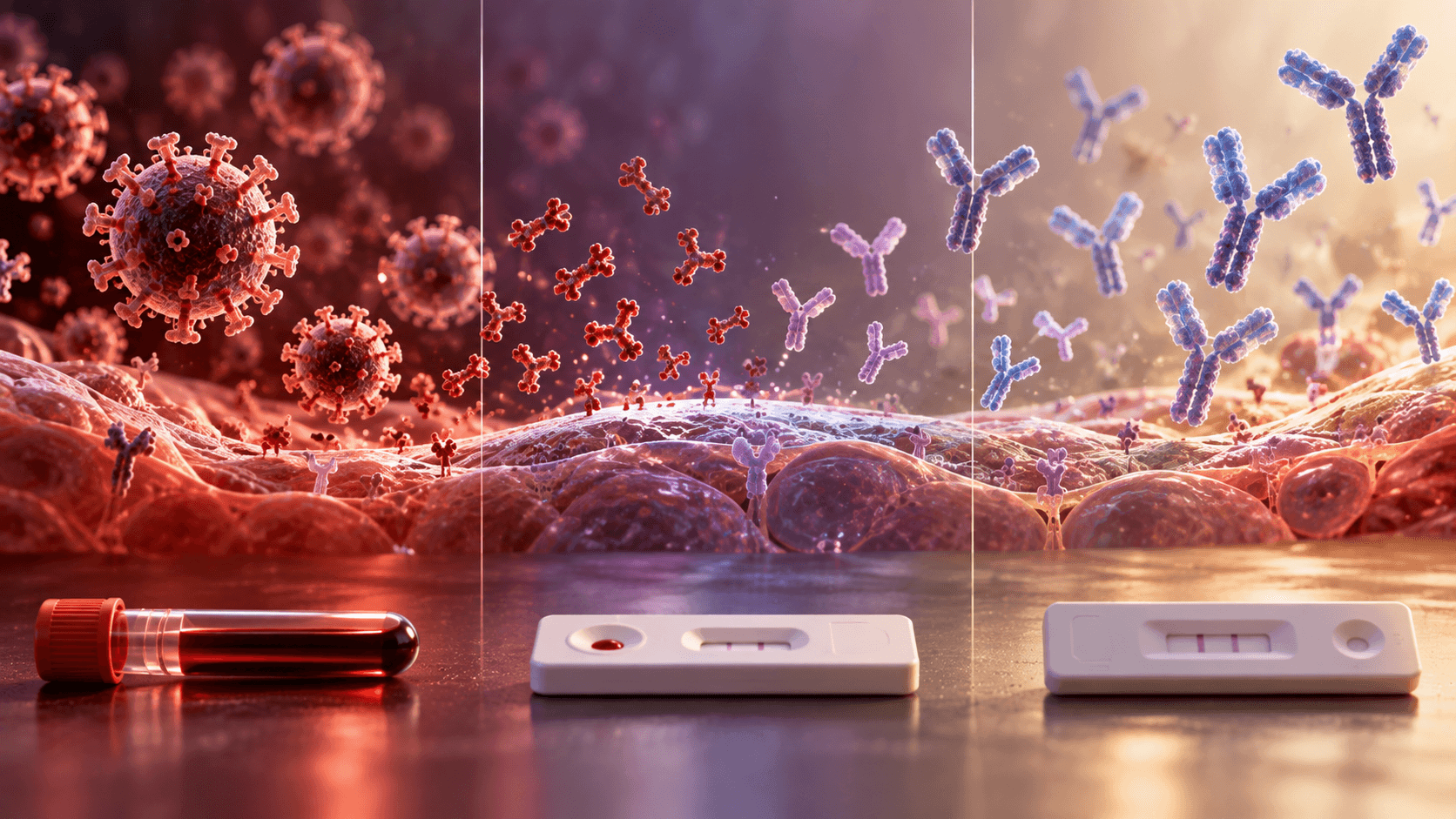
At-home HIV testing can help people check their HIV status privately, quickly, and without scheduling a clinic visit. For many people, that privacy lowers a barrier to testing. But at-home tests have limits. A positive result needs follow-up testing, and a negative result may need repeat testing if exposure was recent.
HIV is the virus that can lead to AIDS if untreated. AIDS is a later stage of HIV disease, not something an at-home test diagnoses by itself. HIV testing tells whether HIV markers are detected. It does not stage the disease, measure immune function, or replace medical care.
This guide explains how at-home HIV tests work, what privacy and accuracy details matter, how the window period affects results, and when to call a clinician.
What At-Home HIV Testing Means
HIV self-testing allows someone to take a test at home or in another private place and get a result without being physically tested at a clinic. CDC describes an HIV self-test as an antibody test that can be used at home or in a private location. If the test is positive, follow-up testing with a healthcare provider is needed.
There are also home-collection kits, where a person collects a sample at home and sends it to a laboratory. FDA describes one home collection system as including specimen self-collection materials, prepaid mailing materials, an anonymous registration system, and telephone counseling for results and follow-up.
The key difference is who performs the test. With a rapid self-test, you collect the sample, run the test, and read the result. With a home-collection kit, you collect the sample, but a laboratory performs the test.
At-Home Test Type 1: Oral Fluid HIV Self-Tests
Oral fluid self-tests use a swab from the gums or inside the mouth. They usually detect HIV antibodies, not HIV itself.
- Private and needle-free
- Can provide rapid results at home
- Requires careful reading of instructions
- May miss very recent infection because antibodies take time to develop
FDA states that the OraQuick HIV Self-Test is intended for over-the-counter use, with the tester collecting the sample and performing all assay steps. FDA also says people using the test should carefully read and follow all directions.
At-Home Test Type 2: Fingerstick Blood Self-Tests
Some HIV self-tests use fingerstick blood. These also require careful instructions, sample handling, timing, and result interpretation.
- May detect antibodies from a blood sample
- Requires a fingerstick
- May be easier for some people to trust than oral fluid testing
- Still needs follow-up testing if positive
FDA describes the INSTI HIV Self Test as a rapid, single-use test for detecting antibodies to HIV-1 and HIV-2 in human fingerstick whole blood.
At-Home Test Type 3: Mail-In Collection Kits
Mail-in kits collect blood or another sample at home and send it to a lab. These may provide laboratory-based testing, but results still need to be interpreted with the timing of exposure and the test type.
- May include laboratory processing
- May include phone or online result support
- Requires correct sample collection and mailing
- May take longer than a rapid self-test
FDA has warned that people who prefer testing at home should use FDA-approved or authorized options and should be cautious with unapproved HIV blood sample self-collection kits.
Accuracy Depends on the Window Period
The window period is the time between HIV exposure and when a test can reliably detect infection. This is one of the most important concepts in HIV testing.
- Nucleic acid tests, or NATs, can detect HIV earliest.
- Laboratory antigen/antibody tests can usually detect HIV earlier than antibody-only tests.
- Rapid self-tests are usually antibody tests and may take longer to become positive after exposure.
- A negative test after a recent exposure may need repeat testing after the window period.
CDC says each type of HIV test has its own window period and that NATs can detect HIV the earliest. CDC also advises that if you test after a potential exposure and the result is negative, you should get tested again after the window period for the test you took.
Why a Negative At-Home Test May Need Repeat Testing
A negative at-home test is reassuring only if enough time has passed since the last possible exposure and the test was used correctly.
- Testing too soon can miss early infection.
- User error can affect rapid self-test results.
- Expired or damaged kits may be unreliable.
- Oral fluid antibody tests are not ideal for detecting acute HIV infection.
CDC’s STI Treatment Guidelines state that HIV home-test kits only detect HIV antibodies and therefore will not detect acute HIV infection. When acute HIV infection is suspected after recent exposure, additional HIV RNA testing is recommended.
Why a Positive At-Home Test Needs Follow-Up
A positive self-test should be treated seriously, but it is not the final step. Follow-up testing is needed to confirm the result and start care quickly if HIV is confirmed.
- Do not ignore a positive result.
- Do not assume the result is final without confirmatory testing.
- Contact a healthcare provider, clinic, public health program, or the test support line.
- Avoid donating blood, plasma, semen, or tissue while follow-up is pending.
FDA states that a positive OraQuick self-test result does not mean a person is definitely infected with HIV, but additional testing should be done in a medical setting. CDC also says that if an HIV self-test is positive, a person should go to a healthcare provider for follow-up testing.
Privacy: What At-Home Testing Can Protect
At-home testing can protect privacy by letting a person test in a private location. It may also reduce concerns about being seen at a clinic or having to discuss sexual history before the first test.
- You choose where to test.
- You control who is present.
- Rapid self-tests can provide results without a clinic waiting room.
- Some mail-in programs may use anonymous registration or support lines.
HIV.gov explains that HIV self-testing lets people take an HIV test and find out their result in their own home or another private location. It also notes that HIV test results are generally protected by state and federal privacy laws and can be released only with permission, except in specific public health reporting contexts.
Privacy: What to Check Before Buying
If the test uses an app, website, mail-in lab, or account, read the privacy details before ordering.
- Is the purchase shipped in discreet packaging?
- Does the company collect name, address, email, phone number, or location?
- Does the app store results?
- Can results be deleted?
- Does the company share data with advertisers, partners, or research programs?
- How are positive results handled and reported?
Privacy is part of the product. A rapid self-test with no app may have different privacy tradeoffs than a mail-in test with a lab portal.
Privacy and Public Health Reporting
Confirmed HIV diagnoses are reported to public health departments in the United States so health systems can monitor HIV and connect people to care. This is different from a rapid self-test result sitting at home before confirmation.
For some people, that reporting can feel concerning. A clinician, health department, or HIV testing counselor can explain what is reported, who can access it, and what protections apply in your state.
The important point is that privacy concerns should not prevent follow-up after a positive test. Early treatment protects health and can prevent transmission.
What “AIDS” Means in This Context
An at-home HIV test does not tell whether a person has AIDS. AIDS is diagnosed using clinical criteria such as immune system damage, certain opportunistic infections, or very low CD4 cell counts.
- An HIV test detects HIV markers.
- A CD4 test helps assess immune system status.
- A viral load test measures how much HIV is in the blood.
- Clinical evaluation helps determine stage and treatment needs.
HIV.gov explains that HIV medicine, called antiretroviral therapy or ART, can lower the amount of HIV in the blood to a level too low to be detected by standard lab tests, and that people who test positive should see a healthcare provider as soon as possible so treatment can begin.
When Testing Is Urgent: Possible Recent Exposure
If HIV exposure may have happened in the last 72 hours, do not rely only on an at-home test. Call a clinician, urgent care, emergency department, sexual health clinic, or public health program right away to ask about post-exposure prophylaxis, or PEP.
- PEP is time-sensitive.
- It works best when started as soon as possible after a possible exposure.
- Do not wait for a self-test to turn positive.
- Baseline HIV testing is usually part of PEP care.
CDC’s 2025 recommendations state that nonoccupational PEP should be initiated as soon as possible, but no later than 72 hours after exposure.
When to Ask About PrEP
If ongoing HIV exposure risk is possible, ask a clinician about pre-exposure prophylaxis, or PrEP. PrEP is medicine taken to prevent HIV before exposure.
- Useful for people with ongoing sexual or injection-related HIV risk
- Requires HIV testing before starting
- Requires follow-up testing and monitoring
- Does not prevent other STIs unless condoms and other prevention steps are also used
CDC recommends that clinicians inform all sexually active adult and adolescent patients about PrEP and prescribe it to anyone who asks for it, including sexually active people who do not report specific HIV risk factors.
Accuracy Question 1: Was the Test FDA-Approved or Authorized?
Use tests that are approved, authorized, or otherwise appropriate for home use in your country. Avoid unknown products sold through informal marketplaces.
- Check the test name and manufacturer.
- Check expiration date and packaging integrity.
- Use only the sample type the test is designed for.
- Do not reuse single-use tests.
- Do not mix parts from different kits.
FDA has approved home-use HIV testing options and warns against unapproved blood sample self-collection kits for HIV detection.
Accuracy Question 2: Did You Follow the Instructions Exactly?
Home HIV test accuracy depends on correct use. Read the full instructions before starting.
- Use the correct swabbing or fingerstick technique.
- Wait the correct amount of time before reading the result.
- Do not read the result too early or too late.
- Make sure the control line or control indicator works.
- Call the test support line if the result is invalid or unclear.
FDA emphasizes that it is extremely important for people using OraQuick at home to carefully read and follow all labeled directions.
Accuracy Question 3: Was the Test Too Soon After Exposure?
A test can be used correctly and still be negative if it is taken too soon after exposure. This is why window period matters.
- After a recent exposure, ask which test type is best.
- Ask whether NAT or laboratory antigen/antibody testing is needed.
- Repeat testing after the window period if the first result is negative.
- Do not use a negative early self-test to skip PEP or follow-up.
CDC says antibody tests can take 23 to 90 days to detect HIV after exposure, while lab antigen/antibody tests and NATs can detect HIV sooner.
Accuracy Question 4: Is the Result Invalid or Hard to Read?
An invalid or unclear test should not be treated as negative.
- Repeat with a new test if the instructions say to do so.
- Contact the test support line.
- Use a clinic or lab test if the result remains unclear.
- Seek urgent advice if the unclear result follows a recent high-risk exposure.
CDC says that if a self-test result is invalid, a person will need to use another HIV self-test or find testing at a healthcare provider or testing center.
What to Do With a Negative Result
A negative result means the test did not detect HIV markers at the time of testing. It does not always mean there is no HIV infection if exposure was recent.
- Repeat testing after the window period if there was a possible exposure.
- Seek lab testing if symptoms suggest acute HIV after recent exposure.
- Ask about PrEP if future exposure risk is ongoing.
- Test for other STIs if exposure involved sex.
CDC advises repeat testing after the window period when someone tests negative after a potential HIV exposure.
What to Do With a Positive Result
A positive result needs prompt follow-up. Try to take the next step quickly, even if the result feels overwhelming.
- Contact a clinician, HIV clinic, local health department, or the test support line.
- Ask for confirmatory HIV testing.
- Ask how soon treatment can start if HIV is confirmed.
- Avoid sex or use condoms until follow-up clarifies status and prevention steps.
- Do not share needles, syringes, or injection equipment.
HIV.gov states that if someone tests positive, they should see a healthcare provider as soon as possible so they can start HIV medicine.
What to Do After a Recent Exposure With Symptoms
Acute HIV can cause flu-like symptoms, but symptoms are not reliable enough to diagnose HIV. Some people have fever, sore throat, rash, swollen glands, fatigue, muscle aches, mouth ulcers, or night sweats after recent infection. Others have no symptoms.
- Do not rely on symptoms alone.
- Do not rely on an early antibody self-test alone.
- Ask about laboratory antigen/antibody testing or HIV RNA testing.
- Ask about PEP immediately if exposure was within 72 hours.
CDC’s STI Treatment Guidelines state that when acute HIV infection is suspected, especially after possible sexual exposure within the previous days to weeks and with symptoms or another STI diagnosis, additional HIV RNA testing is recommended.
Buying Checklist: At-Home HIV Tests
Before buying, compare accuracy, privacy, and follow-up support.
- FDA-approved or authorized home-use test
- Clear sample type: oral fluid, fingerstick blood, or mail-in collection
- Expiration date and unopened packaging
- Plain-language instructions
- Support phone number or online help
- Clear explanation of the window period
- Clear instructions for positive, negative, invalid, or unclear results
- Privacy policy if an app, website, lab portal, or mail-in service is used
Do not buy tests that hide their manufacturer, lack instructions, lack expiration dates, or promise to diagnose AIDS at home.
Questions to Ask Before Testing
Before testing, write down a few facts so the result can be interpreted correctly.
- When was the most recent possible exposure?
- Was exposure within 72 hours?
- Were condoms used and did any break or slip?
- Was injection equipment shared?
- Are there symptoms of acute HIV or another STI?
- Is ongoing risk likely, making PrEP worth discussing?
If exposure was recent, the best next step may be urgent clinical care rather than a self-test alone.
What to Bring or Share With a Clinician
If you call or visit a clinician after a self-test, share the details that affect follow-up.
- Test name, sample type, and expiration date
- Date and time of the test
- Result: negative, positive, invalid, or unclear
- Date and type of possible exposure
- Any symptoms, including fever, rash, sore throat, swollen glands, or mouth ulcers
- PrEP, PEP, or HIV medicine use if any
- Other STI symptoms or recent STI diagnosis
This information helps the clinician choose confirmatory testing, repeat testing, HIV RNA testing, STI testing, PEP, PrEP, or treatment linkage.
Common Mistake: Testing Too Early and Stopping There
A negative self-test soon after exposure may be falsely reassuring.
Repeat testing after the window period.
Ask about PEP immediately if exposure was within 72 hours.
Common Mistake: Treating a Positive Self-Test as the Final Diagnosis
A positive self-test is important, but it needs follow-up testing.
Contact a clinician or HIV testing program.
If HIV is confirmed, starting treatment early protects health and reduces transmission risk.
Common Mistake: Confusing HIV Testing With AIDS Staging
An HIV self-test does not diagnose AIDS. It only reports whether HIV markers were detected by that test.
A clinician uses additional testing, such as CD4 count and viral load, to understand immune status and treatment needs.
Do not delay care because you feel well. HIV can be present without obvious symptoms.
Common Mistake: Ignoring Other STI Testing
An HIV test does not check for chlamydia, gonorrhea, syphilis, hepatitis B, hepatitis C, herpes, HPV, or pregnancy.
If there was sexual exposure, ask whether other STI testing is needed.
Some STIs can increase HIV risk and need treatment on their own.
Common Mistake: Skipping Privacy Details for Mail-In Tests
Mail-in tests and app-connected services can be convenient, but they may collect more personal information than a rapid self-test.
Read the privacy policy before ordering.
Check how results, samples, billing, shipping, and account data are handled.
When to Call a Clinician
Call a clinician, urgent care, sexual health clinic, HIV testing program, or public health department if you have a positive self-test, an invalid or unclear result, possible exposure within 72 hours, symptoms after recent exposure, a negative test taken before the window period ended, or ongoing HIV risk that may make PrEP appropriate.
You should also call if you are pregnant, trying to conceive, breastfeeding, have another STI diagnosis, were sexually assaulted, shared injection equipment, or need help telling a partner or finding confidential testing.
A clinician may recommend confirmatory HIV testing, HIV RNA testing, laboratory antigen/antibody testing, repeat testing after the window period, PEP, PrEP, STI testing, hepatitis testing, pregnancy testing, counseling, or linkage to HIV treatment if confirmed.
When to Seek Urgent or Emergency Care
Seek urgent care immediately if possible HIV exposure happened within the last 72 hours and PEP may be needed. Do not wait for an at-home test to become positive.
Seek emergency care after sexual assault, severe injury, suicidal thoughts, feeling unsafe, severe allergic reaction, severe illness, confusion, fainting, chest pain, severe shortness of breath, or symptoms that feel life-threatening.
If an HIV test result causes panic, thoughts of self-harm, or feeling unable to stay safe, call or text 988 in the U.S. for the Suicide & Crisis Lifeline, or call emergency services if there is immediate danger.
The Bottom Line
At-home HIV testing can make testing more private and accessible. Rapid self-tests can provide results at home, while mail-in collection kits may involve laboratory testing after home sample collection. Both approaches require correct use, attention to the window period, and follow-up when results are positive, invalid, unclear, or too soon after exposure.
A negative result is most useful when enough time has passed since the last possible exposure. A positive result needs follow-up testing. A home test does not diagnose AIDS, measure viral load, count CD4 cells, or replace HIV care.
The most common mistakes are testing too early and stopping there, treating a positive self-test as the final diagnosis, confusing HIV testing with AIDS staging, ignoring other STI testing, and skipping privacy details for mail-in tests.
Use at-home HIV testing as a doorway to care, not a dead end. If exposure was recent, symptoms are present, or the result is positive or unclear, call a clinician or testing program promptly.
Medical disclaimer: This content is for informational purposes only and is not a substitute for professional medical advice, HIV diagnosis, confirmatory testing, HIV treatment, PEP, PrEP, STI testing, pregnancy care, counseling, sexual assault care, mental health care, or emergency care. Always consult your physician, HIV clinician, infectious disease specialist, sexual health clinic, pharmacist, public health department, counselor, or qualified health provider. If possible HIV exposure occurred within 72 hours, seek urgent medical advice about PEP. If you have severe illness, sexual assault, suicidal thoughts, chest pain, severe shortness of breath, confusion, fainting, or another emergency, seek urgent care right away.